This year the Women's Hiking group will start its weekly hikes at Seth
Low Pierrepont State Park. But who was Seth Low Pierrepont? He was a
millionaire and ex-diplomat who served as a US official in Italy, France
and Chile. He was also chief of the American Division of the US State
Department. In the early 1930's he purchased this large tract of land
from the Scott family and made it into his estate. Upon his death in
1956, he gifted it to the CT State Park & Forest Commission. Its 313
acres contains trails with views, Lake Naraneka (Pierrepont Pond) and
history.
The Scott family has a long history in Ridgefield. David Scott was
one of the original Proprietors and purchased lot 13 on June 3, 1712.
The family included a number of Ridgefield patriots, tanners, millers
and of course farmers. When Rana Scott married John Barlow Jr. in 1789,
this area was already referred to as the Scotland District and was a
thriving community. It is the old foundation of the Scott house dating
from 1720's that can be seen at the boat launch. Hints of their farming
life can be seen in the stonewalls throughout the park and the cellar
holes on the northern end of the park. One of these cellar holes was
John Barlow's blacksmith shop. What is now Old Barlow Mountain Road was a
main thoroughfare into town. General Wooster led his troops along it on
his way to meet the British Army in what was to become The Battle of
Ridgefield. Scotland & Barlow Mountain Elementary Schools along with
Scott's Ridge Middle School bear the legacy of this family.
(This post first appeared on Sept 27, 2010 & Sept 5, 2011
Wednesday, August 28, 2013
Tuesday, August 27, 2013
As school starts up, it's time to get hiking again.
The DC Women's Hiking Group will start up for the season on Thurs., Aug. 29th.
We will hike at Seth Low Pierrepont State Park in Ridgefield.
The park is located on Barlow Mt. Rd. across from Scotland and Barlow Mt. Elementary Schools.
Meet in the parking area at 8:30am.
The DC Women's Hiking Group will start up for the season on Thurs., Aug. 29th.
We will hike at Seth Low Pierrepont State Park in Ridgefield.
The park is located on Barlow Mt. Rd. across from Scotland and Barlow Mt. Elementary Schools.
Meet in the parking area at 8:30am.
Tuesday, August 20, 2013
Blue Moon of August 2013
Blue Moon Rises Tonight: 5 Amazing Facts
by Miriam Kramer, Staff Writer | August 20, 2013 10:58am
ET from Space.com
When the full moon rises tonight (Aug. 20), it will
technically be a Blue Moon, but not for the reason you might think.
The Blue Moon tonight is not
the second full moon of August, but actually gets its name from a relatively
obscure rule of astronomy. And there are a few other details about the full
moon that might surprise you.
So to celebrate the Blue Moon, here are five amazing facts about
this month's full moon:
1) It is not really blue: Okay,
so not really a newsflash, but the Blue Moon's name actually has nothing to do
with color. Occasionally, the full moon can take on a reddish pallor, but
today's full moon is not related to the actual color of Earth's cosmic
neighbor. The moon can appear blue in color if a forest fire or volcanic
eruption litters the upper atmosphere with ash or smoke. A volcanic eruption
gave the moon a bluish tint from the perspective of many people on Earth in
1991.
2) There are two definitions for Blue Moon: The
term Blue Moon was originally assigned to the third full moon in a four moon
season, but after a mix up in "Sky & Telescope" magazine in 1943,
the term took on a different meaning. An article in the magazine incorrectly
defined a blue moon as the second full moon in a single month, but the
definition stuck. This particular blue moon is a technical Blue Moon, but does
not meet the criteria for the second definition. The third full moon in a
four-full-moon season rule was detailed in a 1937 edition of the now defunct
Maine Farmers' Almanac.
3) The Blue Moon has many names:
Today's full moon is also known as the Full Sturgeon Moon, the Green Corn Moon,
the Grain Moon, and the Full Red Moon. Each of the August full moon names come from monikers given to the full
moons of a certain month according to Native American and European traditions.
4) It is only full for a moment:
Although the moon usually looks full one day before and one day after the day
of the full moon, there is technically only one moment when the moon is full in
the sky. Tonight, the moon turns full at 9:45 p.m. EDT (0145 Aug. 21 GMT), when
(weather and light permitting) the moon will be in view for people along the
eastern coast of the United States.
5) It is kind of a rare sight: Blue
Moons occur somewhat infrequently. After today's full moon, another Blue
Moon will not occur again until 2015. The idiom "once in a Blue Moon"
signifies a rare event because scientists had trouble predicting when the
distinctive full moon would happen during any given year.
By Miriam Kramer. Original article on SPACE.com.

Sunday, August 11, 2013
August 2013 Constellation of the Month -- Lyra
Lyra can be easily found by locating the brightest
and northernmost star in the huge and prominent Summer Triangle of stars. This star is Vega
in the constellation Lyra. Lyra is a very small constellation compared
with the two constellations which sandwich it – Cygnus
to the East and Hercules
to the West. Besides Vega, Lyra's most noticeable
feature is an almost perfect parallelogram formed by four stars of roughly similar
brightness. In mythology, Lyra represents
a Lyre, which is a type of hand-held harp
You can't see it with the naked eye, but the diagram
above shows the location of the Ring Nebula, M57. This is rightly the most famous "planetary
nebula" in the sky. Nebulae are
immense clouds of gas, and planetary nebulae those that appear to be spherical
or ring-like in shape. Whereas nebulae
like the Orion Nebula are birthplaces to many stars, planetary nebulae are usually
the remains of a star that has exploded.
Lyra's other notable deep-sky object is the globular
cluster of stars, M57. It has over 30,000 stars, with a total diameter of about
85 light years. Globular clusters have some of the oldest stars in a
galaxy. They were formed outside the
disk of the galaxy (where our sun and most other stars in our galaxy are
located), before the huge cloud of gasses making up the disk coalesced into
individual stars.
Saturday, August 10, 2013
The Perseid Meteor Shower has Returned
August 11 – 12 is the climax of the annual Perseid meteor shower, weather permitting of course.
The best time for viewing is after midnight to the predawn hours when the numbers will be the highest. Find a spot away from a lot of ground lights and look to the northeast. If there is a lot of ground light, look to the darkest part of the sky. Like most meteor showers those with patience see the most. The meteors tend to come in batches out the constellation Perseus, hence the name. However, they can appear in any part of the sky but all their tails will point back to Perseus. This year the moon will have minimal effect on viewing. The Perseids occur every year as the Earth passes through a stream of dust particles and debris from the Comet Swift-Tuttle. These particles hit the earth’s atmosphere at speeds up to 140,000 mph and become heated to form bright streaks across the sky – shooting stars. The shower is at its peak or climax when the earth passes through the middle of the tail debris. For those willing to stay up later or get up extra early, there is an added treat as this meteor show has the most fireballs of all the meteor showers this year. So get out a blanket, lay on your back and enjoy the show. And don't worry if you miss the peak, the show this year lasts from July 17 - Aug 24th. Picture credit: NASA/JPL-Caltech.
Tuesday, July 9, 2013
Signers of the Declaration of Independence - Part IV
Connecticut four signers of the Declaration of Independence were Samuel Huntington, Roger Sherman, Oliver Wolcott and William Williams. Of the four, Huntington and Sherman were present to adopt the document on the 4th. Wolcott who had become ill, had returned to CT. Williams was in route to replace Wolcott.William Williams (Apr. 23, 1731 - Aug. 2, 1811): Born in Lebanon, CT where his father was minister of the Congregationalist Church, Williams followed in his father's footsteps and studied theology at Harvard, graduating in 1751. However, soon afterward, he join the militia to fight in the French and Indian War. This experience soured his opinion of British officers. After the war he opened a store in Lebanon called The Williams, Inc. It was the beginning of his very successful merchant career. He was elected Town Clerk. He held that position for 44 years. He was a Selectman for 25years, served the provincial and later state Legislature for nearly 40 years-during which time he was councilor, member, and Speaker of the House. In 1773 he was made Colonial in the Connecticut Militia. He was elected to the Continental Congress in 1776 to replace the ailing Wolcott. He didn't arrive until July 28 but was present for the formal signing of the document on Aug 2nd. Later he was appointed a member of the committee to frame the Articles of Confederation. In 1777 he was appointed to the Board of War. After the war, he attended the Hartford Convention, where Connecticut ratified the Constitution. Originally sent to vote against its adoption, he decided that Connecticut would benefit from it and he voted for it even though he objected to the clause forbidding religion tests. Williams spent his remaining years as a County Court judge.
Thursday, July 4, 2013
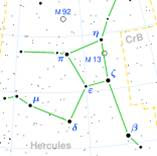
July 2013 Constellation of the Month – Hercules
Last month's Constellation of the Month Corona Borealis, the Northern Crown – is almost
directly overhead about an hour after sunset.
Hercules is sandwiched between Corona, to its West and the Summer
Triangle a much larger grouping of three 1st-magniitude stars which
we featured here on July 2012. That blog post also explains
the magnitude scale.
Although none of Hercules's stars is 1st or 2nd magnitude, it is readily distinguishable by the "Keystone", an asymmetrical rectangle of stars about the size of the crown of Corona Borealis. The Keystone represents the body of the mythological hero Hercules. His two arms extend from the two southern corners and his two legs extend northward. His right foot is stepping on the head of Draco, the Dragon, which is a serpent-shaped circumpolar constellation that we'll feature in this blog next summer.
The constellation Hercules is known for several prominent Globular Clusters. Globular clusters are very old spherical groupings of stars which pre-date the forming of stars in the disk of our Milky Way Galaxy. Almost all the stars in our galaxy are in the disk, but globular clusters are scattered outside the disk. These clusters are made up of 10,000 to several million stars. The stars in each cluster were all formed around the same time, and they are held together in the globular shape by their joint gravitational attraction.
Although none of Hercules's stars is 1st or 2nd magnitude, it is readily distinguishable by the "Keystone", an asymmetrical rectangle of stars about the size of the crown of Corona Borealis. The Keystone represents the body of the mythological hero Hercules. His two arms extend from the two southern corners and his two legs extend northward. His right foot is stepping on the head of Draco, the Dragon, which is a serpent-shaped circumpolar constellation that we'll feature in this blog next summer.
The constellation Hercules is known for several prominent Globular Clusters. Globular clusters are very old spherical groupings of stars which pre-date the forming of stars in the disk of our Milky Way Galaxy. Almost all the stars in our galaxy are in the disk, but globular clusters are scattered outside the disk. These clusters are made up of 10,000 to several million stars. The stars in each cluster were all formed around the same time, and they are held together in the globular shape by their joint gravitational attraction.
Along the western side of the Keystone is M13, considered by many as the finest
example of a globular cluster in the northern sky. Comprised
of about 300,000 stars, it's about half the width of the full Moon, and it's
easily visible with binoculars. North of
the Keystone is M92, the oldest known globular cluster. At 14 billion years old, it's more than twice
as old as our Sun (and Earth). Hercules also has
some interesting binary stars which are resolvable with a small telescope.
Subscribe to:
Posts (Atom)