Wednesday, January 7, 2015

Jan 2015 Constellation of the Month – Auriga


Auriga is a prominent constellation high in the Northeast.  It is north of Taurus, our Jan 2014 constellation of the month, and east of Perseus, our Dec. 2013 constellation of the month. The band of the Milky Way passes through Auriga between Perseus to the West and Gemini to the East.   

Auriga is shaped like a pentagon, or a child's drawing of a house.  It has one magnitude 0 star, Capella, and the other 4 are 2nd magnitude.  Like so many other stars, Capella is a multiple star. It is comprised of 4 stars, made up of 2 binary pairs which orbit around each other.  One is a pair of bright yellow stars in the same category (G) as our Sun.  They are each 10 times as large as the Sun.  This may be because they are expanding on their way to becoming Red Giant stars, which is near the final stage of the life of stars like the Sun.  The other two are red dwarf stars.  These are small-mass stars which are relatively cool.  Red stars – like red flames on earth are cooler than yellow stars like the Sun, which are, in turn, cooler than blue or white stars.  Being of lower mass and cooler than other stars, they evolve more slowly and live longer than massive blue or white stars.

Auriga is home to 3 bright open star clusters – M36, M37, and M 38.  They can all be seen in one field of view with wide-angle binoculars.  Other points of interest are two eclipsing variable stars.  These appear to vary in brightness when viewed from the earth, because the two stars appear either side-by-side or one in front of the other.  Other variable stars actually change their brightness by expanding and contracting. 

Friday, December 12, 2014

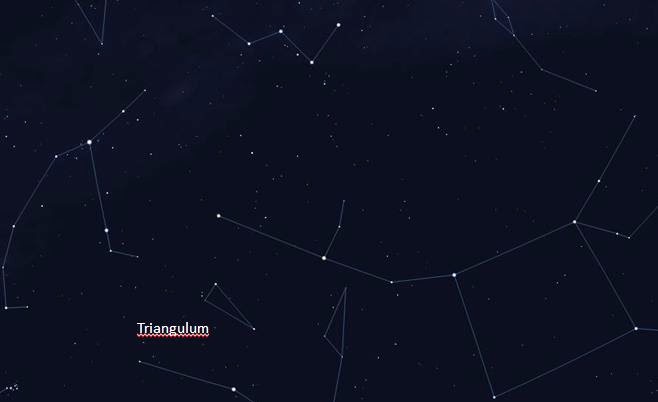
December 2014 Constellation of the Month: Triangulum


To the west of the great square of Pegasus, which we described last month, near the wishbone-shaped Perseus  is Triangulum.  It is a compact triangle with somewhat faint stars, so it will be a little challenging to find.  Some consider it an especially attractive constellation.
The big item of interest in Triangulum is the Triangulum Galaxy, M33.  It is the 3rd largest galaxy in our little Local Group of galaxies – after the Andromeda Galaxy (see Nov. 2012), and our own Milky Way.  When seen through binoculars or a small telescope, like the Discovery Center's, it is about the size of the full moon. 
Which brings us to the question we posed last month:  How many full moons, side-by-side, would it take to stretch across the sky in a line (arc) from the eastern horizon to the western horizon?  The answer is about 360 – which is a lot more than most people guess.  That, coincidentally, is the number of degrees in a circle.  Since the arc we're talking about is a half-circle, the Moon is about ½ degrees in diameter, as it appears to us in the sky.  This, in an extremely unlikely coincidence, is the same size as the disk of the Sun.  That is why, in a full eclipse of the sun, the Moon will almost exactly cover the disk Sun. 

You can prove this half-degree figure for yourself – and maybe win a bet or two, at sunset (or moonset).  When the bottom of the circle of the sun touches the horizon in the West, how long will it take for the Sun to completely set?  The answer is 2 minutes, which is a lot quicker than most people would guess.

Here's how you can use that information to calculate with width of the Sun or Moon in degrees of a circle.  The Sun or Moon traverse across the half-circle (180 degrees) of the sky in 12 hours, which is 720 minutes.  2 minutes is 1/360th of 720 minutes.  1/360th of 180 degrees (the arc of the sky) is ½ degree.


Friday, December 5, 2014

The DC Women's Hiking Group will meet Tues., Dec. 9th and Thurs., 11th at Michael Ciaiola Conservation Area in Patterson, NY.

Take I-84 West to exit 20 for I-684 toward NY-22/White Plains/Pawling.
Keep right at the fork, follow signs for NY 22/Brewster/Pawling and merge onto I-684N.
Continue on NY-22N.
Turn right onto Haviland Hollow Rd.
The Conservation Area will be on the left.
Meet at 8:30am.

Sunday, November 23, 2014

The DC Women's Hiking Group will hike at Quarry Head in Wilton, CT on Tues., Nov. 25th.  No hike Thursday, Nov. 27th.  Happy Thanksgiving!

 Take Rt. 35 past the fountain and follow onto Rt. 33 into Wilton.
There will be a State of CT brown sign on the left hand side between mailboxes #760 and #764.
Turn left into the road and follow up the hill.
There will be a sign for parking up ahead.
Meet at 8:30am.

Sunday, November 16, 2014

The DC Womens Hiking Group will meet at Lewisboro Park in NY this week, Tues., Nov. 18th and Thurs., Nov. 20th.
Located on the south side of Rt. 35 between Mead Street and Bouton Road in South Salem.
Turn at white sign for Lewisboro Park off of Rt. 35 and follow up hill to upper parking area.
Meet at 8:30am.

Monday, November 3, 2014

The DC Women's Hiking Group will hike Thurs., Nov. 13th at Florida Refuge in Ridgefield, CT.
No school on Tues., Nov. 11th, so no hike planned.
Take Rt. 7 and turn onto Florida Hill Road. Make a right onto High Valley Road.
Park along the side of High Valley Road closest to Florida Hill Road.
Meet at 8:30am.
The DC  Women's Hiking Group will hike Thursday, Nov. 6th at Weir Farm.
No school on Tuesday, Nov. 4th, so no hike planned.

 Take Branchville Road and follow National Park signs to Weir Farm.

 Meet in parking lot on Nod Hill Rd. across from historic buildings at 8:30am.