
The DC Women's Hiking Group will hike this week Tues., Dec. 20th and Thurs., Dec. 22nd at Pierrepont State Park.
Meet in parking area off of Barlow Mountain Road at 9:30am.
Wishing everyone a very Merry Christmas and a Happy New Year!!
The group will meet again when school starts up on Tues., Jan. 3rd.
Monday, December 19, 2011

Thursday, December 8, 2011
Constellation of the Month - Cassiopeia, the "W"
 Cassiopeia is a "W"- shaped
constellation almost directly overhead and slightly north in December
soon after sunset. Cassiopeia is an interesting constellation for
several reasons.
Cassiopeia is a "W"- shaped
constellation almost directly overhead and slightly north in December
soon after sunset. Cassiopeia is an interesting constellation for
several reasons.
1. It's Circumpolar:
It's one of a few constellations that never rise and never set.
They just (appear to) go in circles around the North Star -- every
day a circle, and every year a much slower circle. At 6AM tomorrow
it will be low in the sky to the north, and 6 months from now in the
evening, it will be about the same place.
If
you lived at the North Pole, all the stars you could see would be
circumpolar. But they'd only be half the stars in the sky, because
the other half -- which you would never see -- would be circumpolar
for those penguins looking up from the South Pole.
2. It's always opposite the Big
Dipper,
with the North Star about midway between them. So, if you look north
from Cassiopeia, and keep going north and lower in the sky, you'll
find the Big Dipper low in the north. 3 months ago and 3 months from
now, they were opposite each other east to west.
3. The band of the Milky Way
goes through it.
We're in the Milky Way galaxy, which is shaped like a disk. When we
see it as a fuzzy band of many, many stars, we're looking along the
plane of the disk, so we see what looks like a band of stars. When
we look anywhere except along this plane we just see a few stars that
are close, and that's what the rest of the sky (outside the band) looks like.
Sunday, December 4, 2011
The DC Women's Hiking Group will meet Tues., Dec. 6th and Thurs., Dec. 8th at Scott Preserve in Redding, CT at 9:30am.
From the north down Rt 7. Turn left onto Old Redding Rd (I believe that is where Walpole used to be). Right after you go under the RR bear right onto Mountain Rd. Take Mountain Rd to Peaceable St and turn left onto Peaceable. The parking for the open space is on the left. I don't remember how far along on Peaceable it is, but I believe if you come to an electrical substation on the right you have gone too far.
There is limited parking, so please carpool, if possible.
From the north down Rt 7. Turn left onto Old Redding Rd (I believe that is where Walpole used to be). Right after you go under the RR bear right onto Mountain Rd. Take Mountain Rd to Peaceable St and turn left onto Peaceable. The parking for the open space is on the left. I don't remember how far along on Peaceable it is, but I believe if you come to an electrical substation on the right you have gone too far.
There is limited parking, so please carpool, if possible.
Wednesday, November 30, 2011
Friday, November 11, 2011
Women Hiking Group - Nov 15 & 17
The DC Women's Hiking Group will hike at Bennett's Pond on Tues., Nov. 15th and Thurs., Nov. 17th.
Take Route 7 north to Bennett's Farm Road on the left.
The park entrance and parking area will be on the right.
Meet at 9:30am.
Take Route 7 north to Bennett's Farm Road on the left.
The park entrance and parking area will be on the right.
Meet at 9:30am.
Thursday, October 27, 2011
Sunday, October 23, 2011
Sunday, October 16, 2011
CT's Cougar - A Real Wanderer

The cougar killed on the Wilbur Cross Highway in June turned out to be on a long journey. After extensive research, CT DEEP has just published its report in the Connecticut Wildlife Magazine (September/October 2011 issue). Our cougar started its adventure in South Dakota, traveled to Wisconsin, probably continued though southern Ontario and into upper New York State before its untimely demise in Milford – approximately 1,200 miles. This was determined through DNA samples of scat and hair taken by authorities in SD, WI, and NY. It was a young male, 2 – 5 years old who was probably looking for love. Young males are known to disperse fairly long distances looking for a mate and will continue to move along until they find one. But as far as wildlife experts are concerned, our cougar wins first prize. Second prize goes to another South Dakota male that traveled 640 miles to Oklahoma. Young cougar females don’t disperse as far as their brothers. They tend to wander only 12 – 40 miles away from their mother’s territory. Because of this, wildlife experts don’t think New England will see the development of its own cougar population. For a young female to disperse this far and begin reproducing is less probable. But, nature always provides us with wonderful surprises.
Friday, October 14, 2011
Women's Hiking - Oct 18th & 20th
The DC Women's Hiking Group will hike Tues.,Oct. 18th and Thurs.Oct.20th at Tarrywile Park in Danbury.
Take 84 to the Airport Exit.
Take a right at the light at end of ramp.
Follow road to stop sign and make sharp right turn onto Southern Blvd.
Stay on Southern Blvd. There will be signs for Tarrywile Park.
Follow signs and make a right to Tarrywile.
Immaculate H.S. will be on the left and the parking lot for Tarrywile will be on the right side.
Meet at 9:30am.
Take 84 to the Airport Exit.
Take a right at the light at end of ramp.
Follow road to stop sign and make sharp right turn onto Southern Blvd.
Stay on Southern Blvd. There will be signs for Tarrywile Park.
Follow signs and make a right to Tarrywile.
Immaculate H.S. will be on the left and the parking lot for Tarrywile will be on the right side.
Meet at 9:30am.
Tuesday, October 11, 2011
Women's Hiking Group - Oct 13th only
The DC Women's Group will hike Thursday, Oct. 13th at Weir Farm.
No school on Tues. the 11th.
Please meet at Ancona's on Branchville Road at 9:25am and then carpool to Weir Farm because of limited parking on site.
No school on Tues. the 11th.
Please meet at Ancona's on Branchville Road at 9:25am and then carpool to Weir Farm because of limited parking on site.
Monday, October 10, 2011
A Bit of Ridgefield History - Joshua King
 The final Jeopardy question: “During the Revolutionary War, in 1780 he was executed in NYC. His body was later moved to Westminster Abbey”. The answer: British Major John Andre who was capture carrying suspicious papers which later turned out to be Benedict Arnold’s plans for the capture of West Point. During Major Andre’s imprisonment, trial (picture) and execution as a British spy, Patriot Lt. Joshua King was in charge of his safekeeping. They became so close that King remorsefully escorted Andre to the gallows. In 1817 King wrote a letter describing his time with Andre which is now considered to be the most accurate account of the event. What connection does this have to Ridgefield? Joshua King met one Anne Ingersoll, daughter of Ridgefield’s Rev. Ingersoll, during his early days in the Sheldon’s Dragoons. He was so infatuated with her, after the war he came back to Ridgefield where in 1783 he married her. He went on to be a prominent and wealthy member of the community. He served as First Selectman 9 times, represented the town in the State Legislature 10 times and was a Delegate from Ridgefield to the CT Constitutional Convention. His wealth allowed him to build an elegant house. Upon his death, the street where it stood was renamed King’s Lane – the same King’s Lane of today! (To learn more about Joshua King go to The Ghosts of Ridgefield program description and click learn more about the ghosts.)
Saturday, October 8, 2011
"Liberty Tea" - The Goldenrod
 Nothing says fall like the blooms of goldenrods. These plants are found just about everywhere, are easy to grow and come in about 160 varieties. Their reputation has been marred by the rumor that they cause hay fever. Not true! It is the nondescript ragweed that frequently grows near it which is the real culprit. Goldenrod is in fact a very versatile plant. It is a great source of pollen for late honey making and parts of some species are edible. The Native Americans called it “sun medicine” and used it to treat everything from wounds and fevers to rheumatism and toothache. Modern herbalists use it to counter inflammation and irritation caused by bacterial infections or kidney stones. Outside of the medicine cabinet it is still used as a dye. After the Boston Tea Party in 1773, colonist combined it with other herbs to create a tea substitute – “Liberty Tea”. With its ability to grow in a variety of places, it became a cash crop. Sweet Goldenrod was cut, dried and baled, then shipped to England as an apothecary shop item. It even was sent to China as a high priced tea substitute. In the garden and wild it is an important food source for a wide variety of beneficial insects. In Europe it has long been prized as a garden plant. So as you walk through the woods, meadow or garden, admire the plant for what it is – An American Treasure.
Sunday, September 25, 2011
Women's Hiking Group Sept 27 only
The DC Women's Hiking Group will meet at Aldrich Park in Ridgefield at 9:30am Tues., Sept. 27th.
No hike on Thurs. the 29th due to no school.
From Rt. 35, turn onto Farmingville Rd. and turn left onto New Rd.
Parking will be on the left.
From Rt. 7, turn onto New Rd. and follow up to parking area on the right just before intersection with Farmingville Rd.
No hike on Thurs. the 29th due to no school.
From Rt. 35, turn onto Farmingville Rd. and turn left onto New Rd.
Parking will be on the left.
From Rt. 7, turn onto New Rd. and follow up to parking area on the right just before intersection with Farmingville Rd.
Friday, September 16, 2011
The D C Women's Hiking Group will hike this week Tues., Sept. 20th and Thurs., Sept. 22nd, at Topstone Park in Redding, CT.
Take Rt. 7 to Topstone Rd. Follow across R.R. tracks continuing on Topstone Rd.
Keep on Topstone Rd. till turns to dirt Rd.
Shortly after there will be a parking area on the right.
Meet at 9:30am.
Take Rt. 7 to Topstone Rd. Follow across R.R. tracks continuing on Topstone Rd.
Keep on Topstone Rd. till turns to dirt Rd.
Shortly after there will be a parking area on the right.
Meet at 9:30am.
Monday, September 5, 2011
Seth Low Pierrepont State Park
 This year the Women's Hiking group will start its weekly hikes at Seth Low Pierrepont State Park. But who was Seth Low Pierrepont? He was a millionaire and ex-diplomat who served as a US official in Italy, France and Chile. He was also chief of the American Division of the US State Department. In the early 1930's he purchased this large tract of land from the Scott family and made it into his estate. Upon his death in 1956, he gifted it to the CT State Park & Forest Commission. Its 313 acres contains trails with views, Lake Naraneka (Pierrepont Pond) and history.
The Scott family has a long history in Ridgefield. David Scott was one of the original Proprietors and purchased lot 13 on June 3, 1712. The family included a number of Ridgefield patriots, tanners, millers and of course farmers. When Rana Scott married John Barlow Jr. in 1789, this area was already referred to as the Scotand District and was a thriving community. It is the old foundation of the Scott house dating from 1720's that can be seen at the boat launch. Hints of their farming life can be seen in the stonewalls throughout the park and the cellar holes on the northern end of the park. One of these cellar holes was John Barlow's blacksmith shop. What is now Old Barlow Mountain Road was a main thoroughfare into town. General Wooster led his troops along it on his way to meet the British Army in what was to become The Battle of Ridgefield. Scotland & Barlow Mountain Elementary Schools along with Scott's Ridge Middle School bear the legacy of this family.
(This post first appeared on Sept 27, 2010
Women's Hiking Group Starts another Year!
The Discovery Center Women's Hiking Group will start up for the year meeting at 9:30am Tues., Sept. 13th and Thurs., Sept. 15th at Pierrepont State Park.
Located on Barlow Mountain Rd.
Please meet in the parking lot.
Located on Barlow Mountain Rd.
Please meet in the parking lot.
Sunday, August 28, 2011
Irene

My Ridgefield friend's roof is now growing a tree but all are safe within. According to the Ridgefield Press, power is out in more than half the town and trees are down on almost every road. Pope's hill (steep part of Ridgebury Road) is closed and there is flooding on Rt 116 near Barlow Mountain Road. Irene hasn't progressed to New York yet and Ridgefield is already in a state of emergency. This picture from NOAA's GOES-13 satellite shows why. It is indeed a mammoth storm. This note comes from our new home in Alstead, NH 182 miles north of Ridgefield where it has been raining all night. Stay safe - today is a day for board games, cards, reading and just mediating on the fact that nature is in control no matter what man tries to do. Photo: NASA/NOAA GOES project- taking Aug. 27 at landfall in NC.
Tuesday, August 23, 2011
Pluto - Downgraded and Downsized
 It was 5 years ago that the International Astronomical Union downgraded Pluto to a newly created category of dwarf plant. This new category helped explain the ring of icy bodies beyond Neptune that make up the Kuiper Belt. Pluto dilemma was created by the discovery in 2005 of a second major Kuiper object, Eris. Eris was rightly named for the Goddess of discord and strife. She is credited with stirring up enough jealously and envy to cause the Trojan War and now centuries’ later discord among astronomers. When discovered by American Clyde Tombaugh in 1930, Pluto was thought to be larger than Mercury and possibly bigger than the Earth. Since then it has been downsized to about 1,455 miles across which is less than 20% as large as Earth. Plus it is 0.2% of Earth’s mass. It’s extremely elliptical orbit is not on the same plane as the eight official planets and at times makes it overlap Neptune orbit. During this time it is closer to the sun than the gas giant. It takes 248 Earth years to complete one circuit around the sun at an average distance of 3.65 billion miles. This distance makes Pluto one of the coldest places in the solar system with surface temperatures hovering around -375ºF. It has 4 known moons, Charon, Nix, Hydra and a newly discovered tiny one presently called P4. Charon is about half the size of Pluto which leads some astronomers to regard Pluto and Charon as a double dwarf planet or binary system. Even though it is smaller than Earth’s moon, Pluto has managed to hold onto a thin atmosphere composed mainly of nitrogen, methane and carbon monoxide that extends about 1,860 miles into space and changes color. Just recently it discovered by NASA’s New Horizon spacecraft that Charon also has an atmosphere. New Horizon should reach Pluto in July 2015 giving us a new outlook on the tiny worlds at the edge of our solar system. Info credit to Space.com Photo credit Space photos comparing USA/Pluto/Charon
Tuesday, August 16, 2011
The Truth about Raindrops
 We all know how raindrops are shaped, like little teardrops. This is justified whenever we see a dripping faucet or any picture in publication whether in paper form or on the net. However, this is NOT the case. The common raindrop actually goes through an evolution of shapes none of which are tear shaped. Little raindrops, which we will call droplets that have a radius of less than 1mm are spherical. As they fall from the sky they collide with other droplets. Some of these droplets are adsorbed to create bigger droplets. As it grows the surface tension of the water and the pressure of the air pushing up against the bottom of the drop start to create a more hamburger bun shape. If more droplets are absorbed and the size continues to increase, the raindrop will flatten and develop a depression. If it continues to grow, the drop eventually become parachute shaped until the thin umbrella top can no longer hold its shape and it explodes into smaller droplets. If you want to get deeper in the subject, check out Alistair B. Fraser’s Web page “Bad Rain" at www.ems.psu.ed/fraser/Bad/Badrain.html
Monday, June 27, 2011
Near Miss or Look out Below!
 The "things movies are made of" happened at 1:14PM this afternoon. A small asteroid named 2011 MD whizzed by the earth a mere 7,500 miles above the coast of Antarctica, 2,000 miles south by southwest of South Africa . That would put it beneath some of our geosynchronous satellites which orbit 22,236 miles high. 2011 MD was only discovered last Wednesday (June 22) by LINEAR, a pair of robotic telescopes in New Mexico that scan the skies for near-Earth asteroids. The best estimates suggest that this asteroid is between 29 to 98 feet wide, about the size of a tour bus. This makes it too small to survive the plunge through our atmosphere. Also there is little chance that the rock would hit one of the our satellites. They are too few and too far apart. Objects this large usually fly by the earth every 6 years but not all of them are discovered. On Feb 4, 2011, asteroid 2011 CQ1 came within 3,500 miles of us. Rocks that zoom by this close are jettisoned back out into space as shown in the picture provided by Space.com. Scientist frequently use this doglegged shift in trajectory when propelling satellites through space. The acceleration caused by it means less fuel consumption by the satellite.
Tuesday, June 21, 2011
Summer Solstice

Today is the “Longest” day of the year - the Summer Solstice. Called a variation of Midsummer by most northern cultures, this marks a day of great celebration. When man determined time by the sun and moon, midsummer was the middle of the growing season. Most celebrations took on a joyous quality. At Midsummer food was easier to find, herbs could be gathered and crops had been planted in anticipation of a bountiful harvest. It was considered by some cultures a good time to wed as it fell between the intense work of planting and harvesting of crops. The “downtime” could be spent in preparation and celebrations. In China it was a time of balance. Midsummer celebrated the earth, the feminine, and the yin forces. It complemented the winter solstice which celebrated the heavens, masculinity and yang forces.
Now with modern technology driving our lives, it is barely noticed. However, the natural world will be resetting its internal clocks to reflect the eventual slide toward the cold season. Now is the time for second clutches of eggs or litters and for the young to start their intense survival training. Sunlight drives the natural rhythm of plants. The work of photosynthesis has reached its peak and now food production will decline. With the gradual decrease in sunlight some plants will start setting buds for the next growing season. We owe this all to the 23.5º tilt of Mother Earth. It causes sunlight to be unevenly distributed over our planet’s surface as it orbits around the sun. This creates the seasons – the main driver behind the Rhythm of Life.
Monday, June 20, 2011
Women's Hiking June 21 - 23
Join us for our final week of hiking before summer vacation.
The DC Women's Hiking Group will be hiking at Bennett's Pond on Tues., Jun. 21 and Thurs., Jun. 23rd.
From Rt. 7 heading north, take a left onto Bennett's Farm Rd. and the parking area will be on the right hand side of the road.
From Rt. 35 leaving town, take a left onto Limestone Rd. then take a right onto Great Hill Rd.
Follow Great Hill to end and take a right onto Bennett's Farm Rd.
Parking area for Bennett's Pond will be on the left side of the road.
Meet at 9:30am.
The hiking group will start up again in the fall.
Have a wonderful summer!
The DC Women's Hiking Group will be hiking at Bennett's Pond on Tues., Jun. 21 and Thurs., Jun. 23rd.
From Rt. 7 heading north, take a left onto Bennett's Farm Rd. and the parking area will be on the right hand side of the road.
From Rt. 35 leaving town, take a left onto Limestone Rd. then take a right onto Great Hill Rd.
Follow Great Hill to end and take a right onto Bennett's Farm Rd.
Parking area for Bennett's Pond will be on the left side of the road.
Meet at 9:30am.
The hiking group will start up again in the fall.
Have a wonderful summer!
Sunday, June 12, 2011
Women's Hiking June 14 & 16
The DC Womens Hiking Group will hike Tues., Jun. 14th and Thurs., Jun. 16th at Lake Windwing in Ridgefield.
Take Rt. 35 to Limestone Rd. Follow as Linestone turns into Bennetts Farm Rd.
Take a right onto South Shore Dr. which is across from Ridgebury Elementary School.
Turn left into the parking area.
Meet at 9:30am.
Take Rt. 35 to Limestone Rd. Follow as Linestone turns into Bennetts Farm Rd.
Take a right onto South Shore Dr. which is across from Ridgebury Elementary School.
Turn left into the parking area.
Meet at 9:30am.
Tuesday, June 7, 2011
Year of the Turtle

Why did the turtle cross the road? To get to the other side most likely! It is that time of year when female turtles venture from ponds and woodlands to find good nesting sites to lay their eggs. Unfortunately, they are often killed or injured by passing cars.
The Eastern Box Turtle pictured is distinguishable by its high domed shell with sunburst patterns of orange or yellow on a dark background. Box turtles are able to pull themselves completely into their "boxes" or shells, hence their name. Since they take about ten years to reach maturity and lay only a few eggs at a time, their numbers are heavily affected by loss and fragmentation of habitats, as well as road mortalities. They are currently classified as a species "of special concern" in Connecticut.
The Connecticut DEP has declared 2011 the Year of the Turtle to make people aware of the decline of these reptiles. Of the twelve species found in our state, seven are currently categorized as endangered, threatened, or of special concern.
Help a turtle across the road if you can safely do so, but do not relocate it. Be careful of snapping turtles as their powerful jaws are dangerous. Never keep a wild turtle as a pet as many species are protected by law. Instead, observe it in its natural surroundings and hope that it lives to reach 100 years old, as is possible with these long-lived creatures.
Sunday, June 5, 2011
The DC Women's Hiking Group will hike Tues., Jun. 7th and Thurs. Jun. 9th at Tarrywile Park in Danbury.
Take 84 to the Airport Exit.
Take a right at the light at end of ramp.
Follow road to stop sign and make sharp right turn onto Southern Blvd.
Stay on Southern Blvd. There will be signs for Tarrywile Park.
Follow signs and make a right to Tarrywile.
Immaculate H.S. will be on the left and the parking lot for Tarrywile will be on the right side.
Meet at 9:30am.
Take 84 to the Airport Exit.
Take a right at the light at end of ramp.
Follow road to stop sign and make sharp right turn onto Southern Blvd.
Stay on Southern Blvd. There will be signs for Tarrywile Park.
Follow signs and make a right to Tarrywile.
Immaculate H.S. will be on the left and the parking lot for Tarrywile will be on the right side.
Meet at 9:30am.
Monday, May 30, 2011
The D C Women's Hiking Group will hike this week Tues., May 31st and Thurs., June 2nd at Topstone Park in Redding, CT.
Take Rt. 7 to Topstone Rd. Follow across R.R. tracks continuing on Topstone Rd.
Keep on Topstone Rd. till turns to dirt Rd.
Shortly after there will be a parking area on the right.
Meet at 9:30am.
Take Rt. 7 to Topstone Rd. Follow across R.R. tracks continuing on Topstone Rd.
Keep on Topstone Rd. till turns to dirt Rd.
Shortly after there will be a parking area on the right.
Meet at 9:30am.
Tuesday, May 24, 2011
Seth Low Pierrepont State Park
 This week the Women's Hiking group will be exploring the park. But who was Seth Low Pierrepont? He was a millionaire and ex-diplomat who served as a US official in Italy, France and Chile. He was also chief of the American Division of the US State Department. In the early 1930's he purchased this large tract of land from the Scott family and made it into his estate. Upon his death in 1956, he gifted it to the CT State Park & Forest Commission. Its 313 acres contains trails with views, Lake Naraneka (Pierrepont Pond) and history.
The Scott family has a long history in Ridgefield. David Scott was one of the original Proprietors and purchased lot 13 on June 3, 1712. The family included a number of Ridgefield patriots, tanners, millers and of course farmers. When Rana Scott married John Barlow Jr. in 1789, this area was already referred to as the Scotand District and was a thriving community. It is the old foundation of the Scott house dating from 1720's that can be seen at the boat launch. Hints of their farming life can be seen in the stonewalls throughout the park and the cellar holes on the northern end of the park. One of these cellar holes was John Barlow's blacksmith shop. What is now Old Barlow Mountain Road was a main thoroughfare into town. General Wooster led his troops along it on his way to meet the British Army in what was to become The Battle of Ridgefield. Scotland & Barlow Mountain Elementary Schools along with Scott's Ridge Middle School bear the legacy of this family.
Monday, May 23, 2011
Women's Hiking May 24 & 26
The DC Women's Hiking Group will be hiking at Pierrepont State Park in Ridgefield.
The Park is located on Barlow Mountain Rd. near Scotland Elementary and Barlow Mountain Elementary Schools.
Meet in parking lot at 9:30am.
The Park is located on Barlow Mountain Rd. near Scotland Elementary and Barlow Mountain Elementary Schools.
Meet in parking lot at 9:30am.
Afternoon Visitor
 A pair of moving ears caught my eye. Looking down from my desk’s window, there was a gray fox sauntering over the brook’s footbridge and across to the old stonewall. It stopped to listen. Seeing golfers moving down the green, it concealed itself between the stonewall and the ancient sugar maple. Like a child playing peek-a-boo, its head periodically popped up over the stonewall. Occasionally, it wandered around a fallen tree looking frequently back at our birdfeeder but returned to its game of peek-a-boo whenever golfers walked by. Dog and I had seen this little visitor frequently over the winter. Smaller and thicker necked than the more abundant red fox, the gray has a black mane running the length of its tail ending in a definite black tip. Red foxes' tail tips are always white. In pre-colonial times it was the only fox in our area. Now with the return of more forest habitat, they are making a comeback. Well adapted to the woods, they are the only American canine with true climbing ability. They are omnivores with a strong preference for cottontails and other small mammals. As optimists, they also like fruits, insects, birds and more vegetation than reds. But like reds, they change their diet according to what is seasonally abundant. Grays are monogamous, mating in the early part of the year. By now the kits have been born and are hidden somewhere in the rocky woodlands. Both parents tend the litter of 1 - 7 kits. The young are weaned by 3 months, and hunt for themselves at 4 months. The family group will remain together until the fall when the young reach maturity and go off on their own. (Photo from itsnature.org website)
 Wednesday, May 18, 2011
A Necessary Evil
 Even before man developed civilization, flooding was a problem. However, in nature flooding is necessary. It is nature’s way of:
1. Filtering out sediment and pollutants from surface run-off by dispersing it over larger area.
2. Slowing down the speed of run-off allowing it to soak down into the ground. This recharges the groundwater which modern man depends heavily on for potable water.
The area round a waterway that is prone to flooding is called the flood plain or riparian zone. It usually supports a wide variety of plant and animal life. How large an area this zone covers is determined by the slope of the land. Marshes and swamps, commonly now referred to as wetlands, also are part of nature’s system in controlling water flow. They act like sponges and filters and are virtual grocery stores and nurseries for wildlife. When man chooses to build within or alter these wetlands, inevitably there are consequences. Flood plains, marshes and swamps were made to flood. As we learn every spring, man’s control over them is limited. (Photo: Mopus Brook, Ridgefield in flood)
Saturday, May 14, 2011
Women's HIking Group - May 17 & 19th
The DC Women's Hiking Group will hike on Tues., May 17th and Thurs., May 19th at Pine Mountain.
Take Pine Mountain Rd. to near end.
Parking area on right side of Rd.
Meet at 9:30am.
Take Pine Mountain Rd. to near end.
Parking area on right side of Rd.
Meet at 9:30am.
Sunday, May 8, 2011
Women's Hiking May 10 & 12th
The DC Women's Hiking Group will meet at Aldrich Park in Ridgefield at 9:30am May 10th and May 12th.
From Rt. 35, turn onto Farmingville Rd. and turn left onto New Rd.
Parking will be on the left.
From Rt. 7, turn onto New Rd. and follow up to parking area on the right just before intersection with Farmingville Rd.
From Rt. 35, turn onto Farmingville Rd. and turn left onto New Rd.
Parking will be on the left.
From Rt. 7, turn onto New Rd. and follow up to parking area on the right just before intersection with Farmingville Rd.
Thursday, May 5, 2011
Cosmic Psychedelia
 Here is an extraordinary flash back in time. Argentinean astronomers Julia Arias (Universidad de La Serena) and Rodolfo Barbá (Universidad de La Serena and ICATE-CONICET) used the Gemini South telescope in Chile to capture this composite image of the Lagoon Nebula. An all-time favorite of skywatchers on both hemispheres, the Lagoon Nebula (Messier 8, or M8) is among the most striking examples of a stellar nursery in our neighborhood of the Milky Way galaxy. In smaller amateur telescopes, it appears as a pale ghostly glow with a touch of pink. Inside this fuzzy glow is a chaotic environment where new stars are born. It is located in the direction of the constellation Sagittarius in the southern Milky Way. The light to create this psychedelic image took 5,000 years to reach the gigantic Gemini 8-meter mirror. The Gemini Multi-Object Spectrograph (GMOS) on Gemini South captured the light for the spectacular new image from its perch on Cerro Pachón in the Chilean Andes. Thanks to Heidi Hammel for bringing this wonderful image to our attention. For more information go to: http://www.gemini.edu/node/11631
Monday, May 2, 2011
Women's Hiking Group: May 3rd & 5th
The DC Women's Hiking Group will meet Tues. & Thurs. May 3rd & 5th at Lewisboro Town Park in Lewisboro, NY.
Take Rt. 35 from Ridgefield into NY.
Turn left off of Rt. 35 into the park.
Meet at 9:30am.
Take Rt. 35 from Ridgefield into NY.
Turn left off of Rt. 35 into the park.
Meet at 9:30am.
Saturday, April 30, 2011
Tree Planting Tips
 National Arbor Day was April 29, 2011. Trees are necessary part of a healthy environment. An acre of trees can remove 2.6 tons of carbon dioxide from the air at the same time providing 18 people with their yearly supply of oxygen. One tree produces 260 lbs of oxygen a year. Also, they filter out air & ground pollutants, help control run-off, cool their surroundings, reduce surface evaporation, recycle groundwater back into the atmosphere, leaf-fall returns nutrients to the soil and they provide a habitat for numerous creatures while alive and dead. A fallen tree becomes an mini-ecosystem within itself ending with decomposition which creates soil. So celebrate Arbor Day by planting a tree. Here are some tips from the International Society of Arboriculture
1. Dig the hole 2 -3 times the width of the root ball. Do Not dig deeper than root ball depth.
2. Place the tree in the hole. Partially backfill with the soil from the hole, water to settle the soil, then finish back-filling. Tamp the soil gently, but do not step on the root ball.
3. Do not stake unless the tree has a large crown or could be pushed over by wind or people. Stake for one year maximum
4. Wait till next year to fertilize.
Friday, April 29, 2011
The Year of the Turtle
 The turtles have now emerged from their long winter nap. They can be found sunning themselves on a variety of natural and man-made debris or in some secluded woodland spot. Worldwide there are 328 species with 20% of them found in the USA & Canada. But turtles are in trouble. They are the fastest disappearing species on the planet. In CT, 7 out of our 12 species, which includes 4 sea turtles, are either on the endangered, threaten or special concern list. This is why the Department of Environmental Protection has declared this the Year of the Turtle. How can you help them? Leave turtles in the wild; never make them pets. Never release a captive, “store bought”, turtle into the wild. Besides being illegal, it probably won’t survive and they can introduce diseases to the wild population. Do not disturb nesting turtles. If they are nesting in your yard, protect it. It is only temporary. Eventually you will be delighted when the hatchlings emerge. Obviously try to avoid hitting turtles on the road. If it is in June or July, it is probably a pregnant female. If you elect to help it cross, move it onto the side of the road where it is heading. It is going there for a reason and will just try again. Don’t relocate any turtle very far from where you found it. They are territorial and long lived creatures. It may never recover from being moved from its familiar territory. Most importantly, try to learn a little about them. The CT DEP web-site has quick information and links to other sites, plus a Turtle Contest for Kids and a list of CT events. Turtles have existed for 215 million years. Let’s help them stay one of the oldest reptiles on earth. Photo: Eastern Box Turtle - For the CT DEP web-site click here
Tuesday, April 26, 2011
April 26 & 28 Women's Hiking Group
The DC Women's Hiking Group will hike at Ward Pound Ridge Reservation in Pound Ridge, NY
on Tues. Apr. 26th and Thurs., Apr. 28th at 9:30am.
Take Rt. 35 into NY to Rt. 121 and follow signs to Pound Ridge Reservation.
Go in past the parking booth and take 1st right on to Michigan Rd.
Follow Michigan Rd. to end of road and parking area.
on Tues. Apr. 26th and Thurs., Apr. 28th at 9:30am.
Take Rt. 35 into NY to Rt. 121 and follow signs to Pound Ridge Reservation.
Go in past the parking booth and take 1st right on to Michigan Rd.
Follow Michigan Rd. to end of road and parking area.
Thursday, April 21, 2011
Marsh Marigolds - Spring is here to stay!
 The skunk cabbage is the first flower to emerge in the wetlands. Its spadix pops up through the snow sometimes as early as January. But when the yellow blooms of the marsh marigold are first noted dotting our wetlands, spring has finally taken a hold on the land. In the Sarah Bishop Open Space, it was Monday! Their blooms look more like a buttercup than a marigold as in fact it is in the buttercup family – Ranunculaceae. The nectar and pollen are welcomed nourishment for early bees and insects. A native plant it was used for various medicinal purposes. But beware; all parts of the plant are poisonous! Just handling it can cause skin rashes and dermatitis, so preparation required expertise. Because it sickened their livestock, especially cows, colonial farmers were very wary of it. But when its blooms appeared, it meant that the fields could finally be plowed. As with most wildflowers, it has many names – kingcups, water blobs, and sometimes cowslip. Scientifically it is called Caltha (cup) patustris (marsh). Growing along the margins of the wetlands, this beautiful plant takes three years to bloom. So as you are walking along the marsh, swamp or bog, enjoy these little heralds of spring. But remember don’t touch! Beauty sometimes has a bite. (Photo - US Fish & Wildlife, Waubay National Wildlife Refuge)
Friday, April 15, 2011
Frog-sicles?
 The sounds of spring are reverberating throughout the woodlands. Now we mostly hear spring peeper calls. But in some areas, interspersed in the peeper chorus is a series of short raspy quacks. This is the unique call of the wood frog. Wearing a mask and slightly bigger than the spring peeper, this little creature is so incredibly adapted that it can live above the Arctic Circle. Wood frogs inhabit the woodlands eating a wide variety of insects and other small invertebrates. In the late fall, it crawls beneath the forest floor's leaf litter and goes into a hibernation-like state. Over wintering on dry land and above the frost line would kill most cold-blooded vertebrates. But the wood frog is unique in that it can survive being frozen solid - a frog-sicle! In the very early springtime, it emerges from hibernation and immediately gets to the business of breeding. These otherwise solitary animals
 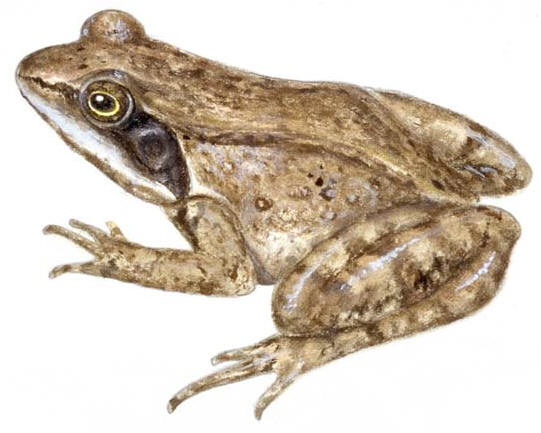 congregate in the large woodland puddles created by snow melt and spring rains called vernal pools. There they mate and lay their eggs in large blobs called mats (see photo) usually attached to some form of vegetation. The eggs become coated in symbiotic algae that helps give oxygen to the developing embryo. This makes them easily mistaken for clumps of algae. Depending on the temperature of the water, the egg to tadpole to frog metamorphosis could take from 50 - 120 days. This fast development is necessary as most vernal pools dry up before summer. If you would like to learn how this frog survives freezing see: http://www.youtube.com/watch?v=Fjr3A_kfspM or type "freezing frog" into You Tube's search.
Women's Hiking Group on Vacation 4/19 & 4/21
The DC Women's Hiking Group will not be hiking April 19th and April 21st. No school. Spring break. Enjoy the break!
Monday, April 11, 2011
Nature’s 360 Million Years Old Miracle
 About 360 million years ago, seed plants began to appear. Before that many land plants used spores to reproduce. Spores have to survive without built-in nutrition or physical protection. Seeds are nature’s way of making sure that plant embryos didn’t dry out and had some energy to start growth. Thus, encased sometimes in a very tiny shell is the plant’s instruction manual awaiting the right amount of water, proper temperature and location. Some seeds, like the mullein, can wait over a 100 years for this to happen. If it is lucky enough to have landed somewhere that meets all three requirements, it will start to grow, called germination. The food supplies stored within the seed provide the energy. First a root will appear pushing downward into the soil to anchor the new plant and provide it with water and minerals necessary for growth. It is the tiny microscopic root hairs that actually do the work (white fuzzies). At the same time or just a little later, a stem will appear pushing its way up through the soil towards the sunlight. Sometimes baby leaves will be on the stem (green). These are called cotyledon or “seed leaf” and are present in the seed prior to germination. They will be the first leaves of the plant. By having these embryonic leaves, the plant will be able to produce food (photosynthesis) soon after the stem has emerged from the soil. This requires less food to be stored in the seed itself. Frequently cotyledons appear different than any future leaf on the plant. Once the stem or shoot appears above the ground it is called a seedling and germination has ended. Now the seed has done its job of providing instructions, energy and protection. If the plant continues to get the right amount of water, sunlight and nutrients, growth will be successful and it will produce its own seeds -insuring the cycle will begin again. (Photo of bean germination www.visions-of-science.co.uk)
Sunday, April 10, 2011
Women's Hiking - April 12 & 14
The DC Women's Hiking Group will be hiking Tues. the 12th and Thurs. 14th at Tarrywile Park in Danbury. Take Rt. 7 to I 84. Take the Airport Exit. At end of ramp make a right and follow to Southern Blvd. Take a sharp right turn onto Southern Blvd. Follow signs for Tarrywile. Take a right into parking area. Immaculate H.S. will be on the left. Meet in the parking area at 9:30am.
Thursday, April 7, 2011
Paper - Where did it come from?
 Paper is a common material with individual Americans using about 580 pounds of it per year. But during much of history, paper was rarely used. In Europe, it wasn’t until the 15th Century that it became a practical item. Johann Gutenburg perfection of the movable type and subsequent printing of the Bible in 1450’s is considered the birth date of modern paper. However, there is much more to the story. In Egypt 5000 years ago, the marsh grass papyrus was soften and woven into mats, pounded thin and left to dry in the sun. The resulting sheets were ideal for writing. It soon became the favored writing medium for the Egyptians, Greeks and Romans. Other cultures developed similar material – the 2nd Century Mayans and some Pacific Islanders. However, these types of mat-like mediums are similar to paper in function but not structure. True paper is thin sheets made from fiber that has been soaked and soften until each individual filament is a separate unit. It was T’sai Lun of China in 105 A.D. who is credited with developing the technique of true paper making. T’sai Lun’s thin, yet flexible and strong paper had a fine, smooth “distinguished” surface perfect for writing. The Chinese kept papermaking a secret until the 3rd Century when it started to creep throughout the Far East. In the 8th Century it reached the Islamic Middle East. The muslin Moors introduced the process to the European continent in the 12th Century. There it slowly caught on replacing the expensive animal skin parchment. Once it was readily available, interest turned back to the Chinese and their printing methods. And it is from them Gutenburg got his inspiration for movable type. But that is not the whole story either! About the same time as Gutenburg’s Bible, the Aztecs of modern Mexico independently developed paper from the agarve plant and were making books called codices - pictured is a copy of a page from the Madrid Codex ca. 15th Century- credit Historyforkids.org
Sunday, April 3, 2011
Women's Hiking Group - April 5 & 7th
The DC Women's Hiking Group will hike at Saugatuck Falls in Redding, CT on Tues., April 5th and Thurs., April 7th. Take Rt. 7 to Old Redding Rd. to the end. Turn right on to Umpawaug. Take first left on to Diamond Hill. Parking on access road between mailbox #65 and #73. Meet at 9:30am.
Friday, April 1, 2011
Blizzard Warning Up Again!
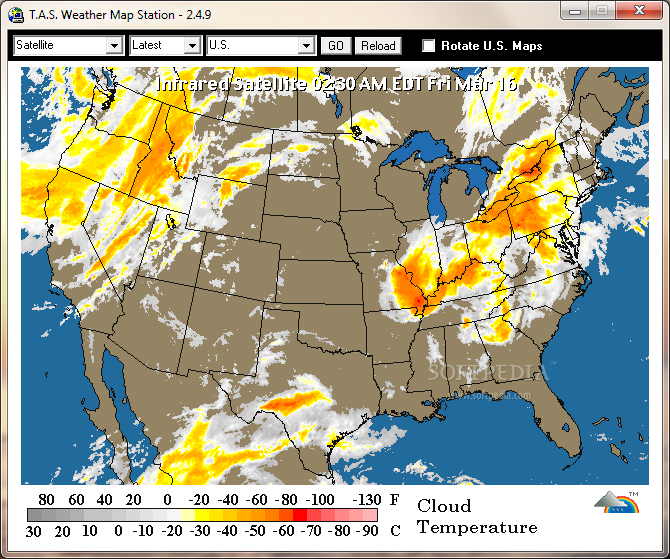 It is another Nor’easter to endure and it is spinning back at us. They said we would get just a little snow and now 11" are predicted. Get your shoveling arms ready. When will it ever Stop????
 Happy April Fools Day! No the storm is blowing out to sea where it belongs. But to what do we owe this day of merriment? There are many theories. One mostly noted is the adoption of the Gregorian calendar in 1582 which placed New Years on January 1st. It replaced the Julian calendar which celebrated the New Year on March 25. It was a weeklong celebration ending on April 1st. Like all change, it wasn’t readily accepted with some folks continuing to celebrate the “old fashion way”. In France they were called “Fools” and the subject of pranks especially invitations to non-existent New Year’s parties on April 1st. Like all folklore this has holes in it. The English didn’t adapt the Gregorian calendar for another 200 years but still enjoyed pranks on April 1st. Some credit the origins of this day of merriment to ancient pagan celebrations that celebrated the Spring Equinox. Apparently the English, Scottish and French colonists brought this day to America. Regardless of its origins, we still enjoy the fun of playing pranks on to this day. But unlike other holidays, no special dinner plans or gifts are required, just a good sense of humor and a smile.
Tuesday, March 29, 2011
Messier Objects: M01 – M110
 While exploring the heavens this Saturday, our amateur astronomers will be giving a tour of some of the 110 Messier Objects. But what are Messier Objects? Charles Messier (1730 – 1817) was a French astronomer of little education, who through observation and perseverance discovered numerous comets and other deep space objects such as nebulae, galaxies, and star clusters. But comets were his passion. Although his discoveries are noteworthy, he is remembered today for compiling and publishing his and other astronomers’ discoveries into a series of catalogs. Each object listed was given a number; the Crab Nebula – M01, Andromeda galaxy – M13 etc. Ironically his purpose in creating the categories was to list those things which he thought were a time waster, “objects to avoid”, when comet hunting. Although excellent at finding comets and deep space objects and making astute observations of a whole range of things from sunspots to eclipses to occultation of astrological objects, he was no mathematician or theoretician and he relied on others to compute the orbit of his comets. His work earned him the position of Chief Astronomer of the Marine Observatory in 1759. He was also elected to the numerous notable Science Academies throughout Europe. Eventually he received the Cross of the Legion of Honor from Napoleon himself. To this day, his lasting legacy, the Messier Catalog, is still used by amateur astronomers all around the world. It includes the majority of the best deep sky objects visible in the Northern Hemisphere.
Saturday, March 26, 2011
Women's Hiking Group - Mar 29 & 31
The DC Women's Hiking Group will hike at Topstone Park in Redding, CT on Tues., Mar. 29th and Thurs., Mar. 31st. From RT. 7, take Topstone Rd. and follow over the RR tracks staying on Topstone Rd. It will turn to a dirt road, shortly after there will be a parking area on the right side of the road. Meet at 9:30am in the parking area.
Monday, March 21, 2011
Spring????
 Yesterday was the spring equinox, Ostara the druids called it. It is the day when daylight and night time are about equal. But in nature, this is but a blur in the rotating seasons. In Ridgebury it is snowing hard today. Dog and I walked around the golf course noticing all the signs that our time out there is limited. Benches, trashcans, containers of sand are all out waiting for the “golfermen”. Yet winter hangs on in our every footprint with snow clinging to my boots & Dog’s fur. The hunter’s feeding station is still there. Winter’s woody debris is still scattered about the fairways. But the ponds no longer are covered in their mantle of ice. Geese cruise on one and Dog has spooked some wood ducks out of another. Skunk cabbage is well into its blooming phase with some leaves even unrolling in places. Man declares it Spring but for nature it is tug-of-war time between the seasons. Photo: Wood Duck by Larry Peterson - http://www.pbase.com/larry1dmarkiii/image/95034506/original
Saturday, March 19, 2011
Women's Hiking Group - March 22 & 24
The DC Women's Hiking Group will hike at Seth Low Pierrepont State Park on Tues., Mar. 22nd and Thurs., Mar. 24th.
Take Rt. 116 to Barlow Mountain Rd.
Meet in the parking lot at 9:30am.
Take Rt. 116 to Barlow Mountain Rd.
Meet in the parking lot at 9:30am.
Supermoon????
 Today at 2:10pm the moon will be officially full. At 3pm, the moon’s orbit will bring it the closest to earth, known as perigee. Today it will be the closes it has been in 18 years, 221,565 miles away. This will make the moon appear 14% larger and 30% brighter than the lesser full moons, when the moon is farthest from the earth, known as apogee. Thus,the media has labeled it “Supermoon”. However, to the casual observer, it will be hard to tell the difference. To view it with maximum effect, look to the distant horizon making sure you have objects such as mountains or buildings in the foreground. As the moon rises behind these objects, it creates an optical illusion which makes it look even bigger to the naked eye. (See photo) Don’t worry if you miss it, the moon will appear full for several more days. However, never fear, if you don't get to see it now, you’ll get another chance in 19 years. Photo credit Stefan Seip -Saguaro Moon - http://apod.nasa.gov/apod/ap070926.html
Friday, March 18, 2011
Today is a Great Day for a Walk
 There are a thousand things to do today. We need milk, material for a home improvement project and garden supplies. But dog insisted we leave all of that behind and go for our morning walk. Yesterday’s warmth really encouraged spring to leap forward. There are bleeding heart shoots coming up now among the tulips. The crocuses are adding color to the lawn. The silence of the winter woods has been replaced by the melodious songs of robins, red-wing blackbirds, and much more. A bluebird flew by giving the gray woods a brilliant dab of blue. Down by the “frog ponds” a lone turtle has emerged from its winter nap. It sat on a log with neck outstretched soaking in the sun. Up on the hill, the hawks are fortifying their nest. Seventeen geese flew overhead in a noisy V. But a sure sign of new life to come floats in the vernal pool next to the road. There bulbous masses of wood frog eggs (see photo) are attached to twigs slowly incubating this year’s tadpoles. Dog and I saw all of this in just a 30 minute walk. So go out and enjoy your day even if it is just for a short while. Winter returns tomorrow.
Thursday, March 17, 2011
Happy St. Patrick's Day!
 Is maith and sceélaí an aimsir! Gaelic: “Time is a good story teller.” And time has created a lot of stories about the Patron Saint of Ireland. Born Maewyn Succat, his story is about enslavement, conversation to Christianity and finally returning to the island of his enslavement to minister to the existing Christians and covert the rest. He did create the Celtic Cross but by his own admission was not a great success at converting the population. His death on March 17, 461 became his Feast Day and has been celebrated in Ireland since the 7th Century. Usually falling during Lent, this was the one day the Catholic Irish could revert back to eating meat and making merry. Using the shamrock to explain the Trinity, driving the snakes out and wearing green (blue was his color) have all become part of his story. The Irish immigrates brought St. Patrick’s Day to us and at times it was a bigger holiday here than in their native land. Boston held the first parade in 1737 with NYC following in 1762. During the massive Irish migration in the 1840’s and the anti-Irish sentiment that followed, St. Patrick’s Day became a way for the Irish to gain acceptance and melt into the American Culture with apparently great success. Lá Fhéile Pádraig Sona Daoibh – Happy St. Patrick’s Day to All!
Tuesday, March 15, 2011
The Iditarod - The Last Great Race
 March Madness usually refers to basketball. But in Alaska it means The Iditarod, a 1,150 mile dog sled race from Anchorage, across the Alaskan interior and along the Bering Strait Sea to the town of Nome. Started in 1973, it has been called the Last Great Race on Earth and has won worldwide acclaim. This year 62 teams of 8 – 16 dogs from the US and 6 foreign countries are competing in this 8 – 17 days long race. Today it will end with two veteran teams running neck and neck along the Bering Strait coastline for Main Street, Nome. It started on March 5th with a ceremonious run through Anchorage. Then portage to Willow, AK where the real race began on March 6th. The teams love to run hard at night so the dogs won’t overheat. But this means serious sleep deprivation for their human mushers. Imagine running hard through the woods at night with just a headlight and the northern lights to guide you. Obstacles and cold, as much as -40º below, are every present. Then only after the dogs are rested & fed, you run again during daylight hours. This race is really all about the dogs, how fit they are and how well they work as a team. The men and women who take on this challenge all love their dogs, the wilderness and view it as an honor to participate in the Last Great Race on Earth. To learn more about it go to www.iditarod.com. Photo: http://thirdgradetrip.wordpress.com/
Friday, March 11, 2011
Women's Hiking - Mar 15 & 17
The DC Women's Hiking Group will be hiking at Bear Mountain and Candlewood Lake in Danbury on Tues. Mar., 15th and Thurs. Mar. 17th.
Take exit 5 off of I-84.
Follow Rt. 37 North past all the shopping centers. Go past the commercialized district and eventually past the federal prison into the more rural part of northern Danbury.
About 0.2 mile past the prison entrance, on the right, is Bear Mountain Road which is 2.8 miles from I-84.
Turn right onto Bear Mountain Road and follow it for 0.5 mile.
Turn right into the entrance of Bear Mountain Reservation.
Meet at 9:30 am.
Take exit 5 off of I-84.
Follow Rt. 37 North past all the shopping centers. Go past the commercialized district and eventually past the federal prison into the more rural part of northern Danbury.
About 0.2 mile past the prison entrance, on the right, is Bear Mountain Road which is 2.8 miles from I-84.
Turn right onto Bear Mountain Road and follow it for 0.5 mile.
Turn right into the entrance of Bear Mountain Reservation.
Meet at 9:30 am.
Tuesday, March 8, 2011
Twitterpated Season

Spring has sprung in the world of nature. This past weekend brought out at least one Jefferson Salamander looking for love in the still frozen over vernal pool. Up in Ridegbury, the red- shouldered hawk cries are heard resonating out of the woods. Back on the New York State line is the nest that has produced a string of these marvelous birds. This winter when the snow was very deep, one hung out at my birdfeeder. These big birds learn early that silence is best while they search for prey. But this time of year, their thoughts turn to other needs and they become quite vocal. Sometimes their courtship takes on such a ruckus that even the crows that love to mob them stay away. Their call is quite distinctive. Listen for yourself - http://www.naturesongs.com/rsha1.wav (cut and paste into your search engine. Photo by Cary Maures - Red Shouldered Hawk #16
March 8th - Women's Hiking Group
DC Women's Hiking group will meet 9:30am at Sturges Park in Ridgefield.
Thursday, March 3, 2011
Snowshoes
 Currently it is believed that snowshoes originated in central Asia about 6,000 years ago. They started out as slabs of wood or bent twigs or branches and rawhide. Slowly they transformed to reflect different types of terrain, kinds of snow conditions and the owner’s needs. In Scandinavia, they eventually evolved into skis. The North American Native Americans are credited with perfecting their features. They developed numerous styles, notably the Alaskan, Obijwa, Michigan, and Bear Paw (see illustration). The Alaskan is long and narrow with upturned toe for breaking trail. It was developed for traversing the deep powdered cover areas of the northwest. The Obijwa’s double-pointed shoes allowed backward and forward movement for the much more varied terrain of the Manitoba region. They were made with speed and ease of movement in mind. The tennis racket shaped Michigan allowed their owners to carry heavy loads. But turning around was difficult and tripping was a common problem. The oval shaped Bear Paw was the most versatile. Being short and wide it allowed for ease of movement through diverse terrain while carrying a heavy load. Modern snowshoes are based on this design. Up until the 1970’s a classic snowshoe was wooden framed with rawhide lacing. Then a gradual revolution in material occurred slowly making them lighter and more durable. In the 1980’s aluminum frames enabled snowshoeing to join in with the growth of running, cycling and Nordic skiing. With the further adaptation of even lighter material, evolution of easier bindings and better traction devices, snowshoeing now has become a common recreational pastime. (Illustration: http://www.winterwalk2006.org/articles/snowwalker.htm)
Tuesday, March 1, 2011
March 1 - Women's Hiking Group
The DC Women's Hiking Group will meet at Bogus Rd. at 9:30am to hike at Hemlock Hills.
Take Ridgebury Rd. to Ned's Mountain Rd. to Bogus Rd.
Take Ridgebury Rd. to Ned's Mountain Rd. to Bogus Rd.
Wednesday, February 23, 2011
Feb. 24 - Women's Hiking Group
The DC Women's Hiking Group will snowshoe on Thurs., Feb. 24th at Weir Farm.
Please meet at 9:25am in the parking lot of Ancona's and then carpool over to Weir Farm.
Please meet at 9:25am in the parking lot of Ancona's and then carpool over to Weir Farm.
What is that sound?
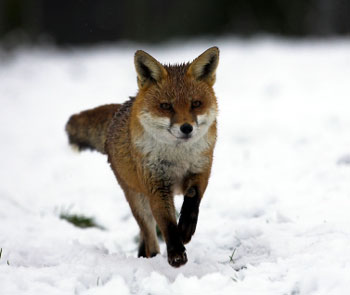
Dogs bark, coyotes howl and foxes scream. This is the mating season of the red fox, a neighbor to all of us in Ridgefield. Like all canines, foxes communicate through a variety of postures and sounds. This winter has been tough on foxes. They prefer to be nocturnal. But now, they are venturing out more and more in the daylight hours searching for food. Or are they venturing out in search of a mate? We have spotted one or two frequently for the past month or so. Regardless of their motive, it is quite an experience hearing one of them howling in that queer high pitched tone they have. The first time I heard it, I thought it was someone in distress. But there on a knoll was a beautiful red fox, howling and screaming, for what reason either my dog or I knew. If you would like to hear the various ways foxes vocalize, here is a link to a great YouTube site:
http://www.youtube.com/watch?v=J6NuhlibHsM
Just copy it and paste it into your search engine. The howl/scream is what we witnessed.
Tuesday, February 15, 2011
Think Pancakes - It's Sugaring Off Time

Sugaring off, or the production of maple syrup, has been an early spring activity for centuries. Native Americans gashed the trees, collected the sap in wooden troughs or bark bowls, let it partially freeze to enrich the sap and then boiled it down by sometimes dropping heated stones into it. At times, it would be tossed onto the snow to freeze into “wax sugar”. But boiling it down into sugar cakes made it easier to carry and store. For Native Americans and the colonists this and honey were their primary sweeteners. It wasn’t until the end of the 1800s that white sugar became abundantly affordable. Gashing trees is no longer done as it can kill a tree and the number of good sugar bushes (groups of good syrup producing trees) isn’t as plentiful anymore. Instead trees are tapped (drilled) with a spile inserted into the hole. Sap runs down the spile into buckets or it is funneled down tubing. Eventually it ends up in large reservoirs that are heated over evaporators. It takes 40 gallons of sap to evaporate down into one gallon of syrup. Sounds simple but good syrup production is a bit of an art. Weather determines when the sap begins to run and when the run ends. Freezing nights and warm days are the herald of sugaring off season. Maple trees of all varieties and the box elder can be tapped. But because its sap has a superior percentage of sucrose, the Sugar Maple is the “Jewel of the Sugar Bush”. (photo Allison S. 2010 - Radishes&Rubarb.blogspot.com) Originally posted on 2/15/11
Monday, February 14, 2011
Women's Hiking Group 2/15 &2/17
The DC Women's Hiking Group will be snowshoeing at Brewster Farm on Tues., Feb. 15th and Thurs., Feb. 17th. Meet at 9:30am.
A chance to see the farm in the wintertime.
Park at the farmhouse right on Lounsbury Rd.
A chance to see the farm in the wintertime.
Park at the farmhouse right on Lounsbury Rd.
Sunday, February 13, 2011
Hibernation - A Special Sleep

Animals in true hibernation can be moved around or be touched without any response. This state is frequently described as sleep but it is far different than regular sleep. In normal sleep, an animal can wake up quickly. With hibernation, the animal appears dead. To wake it takes a very long time; and once aroused, it can’t return. To prepare for hibernation, an animal will eat more than usual in the fall. Instead of putting on normal fat, a special fat is produced which will use as fuel during hibernation. As their body is preparing for hibernation, the animal will get sluggish. Scientists believe body weight determines when it will bed down. Once it enters hibernation, its body temperature drops very low so that it almost matches the outside temperature. Its heart rate and breathing will slow tremendously. All of this conserves energy. It will no longer defecate or urinate as its body will reprocess the liquids. Nor will it lose muscle strength. The whole process is similar to a controlled state of hypothermia but without damage to cells, organs or brain. It is believed an internal clock and possibly hitting a critical level of fat reserves causes the animal to wake up in the spring. In CT only the woodchuck (aka groundhog) & the brown bat hibernate. Some scientists now call this process “complete torpor” and the time period the animal is “asleep” hibernation. Regardless, it is nature’s adaptation to prolonged cold and lack of food. (Photo - Hibernating bats www.arkive.org)
Monday, February 7, 2011
Torpor? Ever Hear of it

This morning a chipmunk’s head poked out of a hole in the snow. Isn’t it supposed to be snuggled down for a long winter sleep? Science is ever changing and research into the wintertime habits of animals has been opening new windows onto how some species conserve energy while enduring winter. Animals thought to be hibernators (i.e. chipmunks & bears) were actually somewhat alert and semi-active during the winter. Bears give birth in the winter, a feat hard to do while asleep. Thus enter torpor, a state of physical inactivity usually accompanied by a slowdown in body functions. When an animal is in torpor, it is sluggish and less alert. Sometimes its heart rate and body temperature will decrease slowing its metabolism. How long it stays this way is determined by how much body fat it has to live off and genetics. Bears can last an entire northern winter, raccoons a couple of weeks, opossums only a couple of days. Some animals go in and out of it frequently. It has been discovered that hummingbirds go into torpor nightly. This research has scientists redefining the term hibernation and discussing degrees of torpor. In the end, it is all about how animals have developed ways to conserve energy so that it can continue to live and thrive despite the lack of food. Next – Hibernation (Photo BioKIDS - Phil Myers University of Michigan)
Saturday, February 5, 2011
Migration isn't just heading south

In New England, the mention of migration has people thinking of fall's noisy flocks of Canada Geese heading southward. The reason behind migration is to move to a new location where there is better food, shelter, and water. Conditions caused by changing seasons are a major force behind seasonal migration. But it is not the only type. Birds’ heading south is latitudinal migration, the movement of animals north and south. Attitudinal migration is the movement of animals up and down major land features such as mountains. By physically moving north and south globally or up and down a mountain, animals are trying to improve their living conditions. Reproductive migration is the movement of animals to bear their young. Some areas provide more food, shelter and protection for rearing young. Or the young of a species requires different living conditions than the adult. Salmon return to fresh water to spawn while the American eels return to the sea. Complete migration is when virtually all of a species, like our hummingbirds, leave their breeding grounds in non-breeding season. Partial migration is when only some of a species, like our red-tailed hawks and herring gulls, leaves the breeding grounds. The herds of wildebeest roaming the Serengeti is nomadic migration. For some species, the journey is not necessarily done by one individual but by generations. The monarch butterfly winters in Mexico. However, not all individuals complete the round trip from CT, but their offspring do. Climate change and/or resource depletion and/or overpopulation are factors in removal migration. In this case, the animals do not return. For our wildlife, habitat fragmentation contributes greatly to this. For humans, removal migration is a major factor in population shifts. Next - Torpor
Thursday, February 3, 2011
How do animals manage to survive winter?
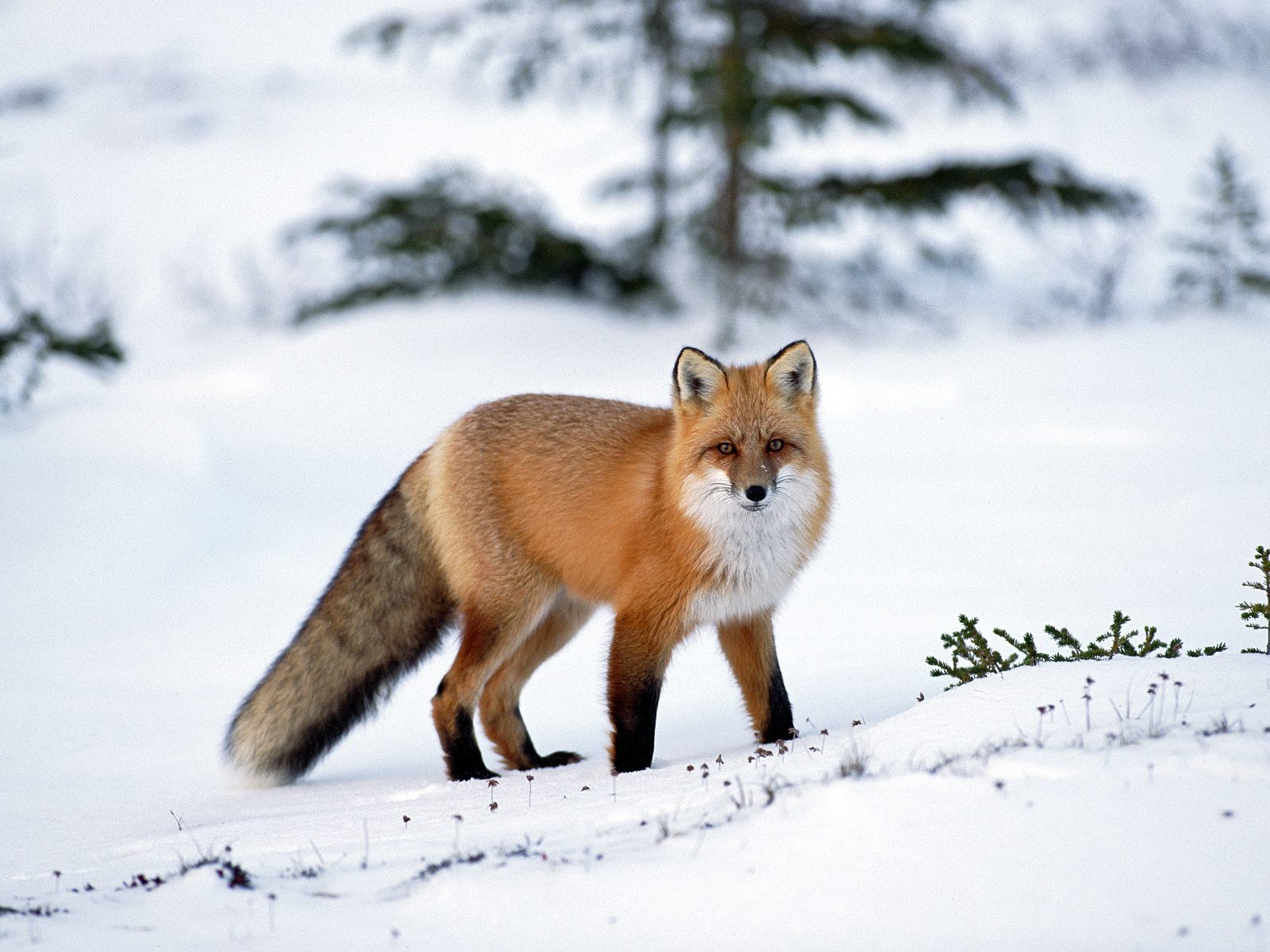
Today the air was clear and cold, while ice covered the trees and encased the snow making it white cement. But above the glistening trees, a flock of vultures rode the thermals and two hawks darted by with an unwanted escort of crows. Suddenly a pair of foxes raced across the field. How do they manage to survive in all this ice and snow? Nature has developed basic strategies to enable animals to deal with winter – endurance, migration, torpor, hibernation, estivation (reptiles & amphibians), and diapause (insects). Endurance means simply to “tough it out”. Deer, the birds visiting your feeders, the foxes and their small rodent prey, are examples of animals that are active all winter long. Throughout the centuries of evolution, they have adapted ways to survive winter. Some change their diet. Deer and rabbits switch from leafy greens to dry weeds and bark. For the deer this involves a gradual change in their stomach’s bacteria. Others, like the beaver and red squirrel, cache (store) food to munch on. Mammals take on a “winter” layer of fur that provides more insulation and sometimes camouflage. The short-tailed weasel changes from brown to white. All put on a thicker layer of fat for the extra energy required to fight the cold, look for food and remain safe. With the exception of birds, most rely on their sense of smell to locate food. Squirrels are sniffing out the nuts they hid in the fall. As are the weasels, foxes, coyotes and bobcats sniffing out their prey. Winter is the ultimate survival test for all who must endure and for some it is the last one. Next - Migration
Wednesday, February 2, 2011
Phil's 2011 Prediction
Happy Groundhog Day! This m orning, Punxsultawney Phil emerged from his stump in Gobbler's Knob to a admiring crowd of "thousands". His handlers, all stately gentlemen in top hats and tails, listened intently to his "Groundhogese". Phil only focused on his duty and not the treats being presented to him, spoke in silent whispers. There are two scrolls - one declaring six more weeks of winter and the other an early spring. His handlers listened intently as he directed them to the proper scroll. Then as if proclaiming a kingly declaration, the prediction was read, "As no shadow could be seen on this beautiful day in Punxsultawney, it is hereby declared that spring will come early this year!
orning, Punxsultawney Phil emerged from his stump in Gobbler's Knob to a admiring crowd of "thousands". His handlers, all stately gentlemen in top hats and tails, listened intently to his "Groundhogese". Phil only focused on his duty and not the treats being presented to him, spoke in silent whispers. There are two scrolls - one declaring six more weeks of winter and the other an early spring. His handlers listened intently as he directed them to the proper scroll. Then as if proclaiming a kingly declaration, the prediction was read, "As no shadow could be seen on this beautiful day in Punxsultawney, it is hereby declared that spring will come early this year!
Monday, January 31, 2011
Will The Groundhog predict winter's final demise?

Wednesday, February 2 is Groundhog Day. According to folklore, it is the day when the groundhog, turned meteorologist, determines if spring will come early. If he see his shadow, it will be 6 more weeks of winter. If instead the day is cloudy, he will declare an early end to the winter season. This traditon originated in Europe where the badger or bear was the star. The Germans who settled in Pennsylvania brought it over, Americanizing it by using the common groundhog or woodchuck. So it is no surprise that the media focuses on a Pennsylvania groundhog, Punxsultawney Phil (photo), as its official prognosticator. According to his web-site he has made 125 predictions and they were all right. Now we have a storm dedicated to the little seer - The Groundhog Day Storm of 2011 described by weather.com as a "multi-day dangerous, destructive winter storm". Will Phil need a shovel to liberate himself from his burrow and more than mear fur as protection once he emerges? Or will his eyes water from the blazing sunlight? We'll have to wait till about 7:35AM Wednesday for the offical announcement which will be web casted on www.visitpa.com/groundhog-day starting at 6:30AM.
Thursday, January 27, 2011
The Bald Eagle
 Haliaeetus leucocephalus is the scientific name for America’s National Bird. It means a sea (halo) eagle (aeetos) with a white (leukos) head (cephalus). At one time, bald meant white not hairless. It is called a sea eagle because of its preference for eating fish although it does eat carrion, smaller birds and rodents. Eagles differ from other birds of prey mainly by their larger size, more powerful build and heavier head and beak. The average adult bald eagle measures approximately 3 feet in length (males are smaller); females have a wingspan of 7 feet while males average 6 feet. Although they only weigh 8-9 lbs (male) 10-14 lbs (female), they can lift about 4 pounds. They live for 20 – 30 years. Eagles mate for life and an established pair may use the same nest for many years. They lay 1-3 eggs. Their chicks fledge in about 20 weeks but don’t reach sexual maturity and their full adult plumage for 4 – 5 years. The Bald Eagle is native only to North America. This is one of the reasons, along with its majestic beauty, great strength, and long life that it was chosen as our National Emblem on June 20, 1782. Second runner up was the American Turkey.
Monday, January 24, 2011
Snowshoe Clinic Experience
 On Jan 23, we held our first snowshoe clinic. Fifteen people came by to try their hand at this easy sport. One attendee, Travily included the experience on her family's blog. Click here to read about it and get an idea of how the clinic works and even take a 10 second virtual hike. Our next clinic is on Feb. 13.
Monday, January 17, 2011
Wednesday, January 12, 2011
Winter Birds

Some visitors to our winter bird feeders are permanent residents. Birds like the blue jay, chickadee, and tufted titmouse live and breed locally merely moving about from one food source to another. Others have migrated into our area for a variety of reasons. The most common reasons are to take advantage of a good food supply and better shelter. Our regular winter visiting songbirds, like the junco (photo) and white-throat sparrow, find our area has a good supply of the seeds and nuts and provides a safer environment then the more northern regions where they spend the summer. Generally the snow is not as deep or long lasting. More importantly, the days are longer allowing them more daylight to feed. Most songbirds have a weak sense of smell and rely on their eyes for finding food. Some of our winter birds only visit us occasionally. Pine siskins, evening grosbeaks and redpolls make their homes in the northern coniferous forest. If there is a poor northern seed crop, they will move further south into our region in search of food. Some years they flock to our feeders, while in other years, they are nowhere in sight. What all our winter songbirds have in common is the ability to eat seeds and nuts. Most of the songbirds that mainly depend on insects or nectar left our area in the fall for better feeding grounds.
Subscribe to:
Comments (Atom)

 Posts
Posts

