
The DC Women's Hiking Group will hike this week, Tuesday, Oct 4 and Thursday, Oct 6th at Tarrywille Park in Danbury:
From I-84 take the airport exit.
At end of ramp turn right.
Follow through traffic lights and at stop sign turn onto Southern Blvd. ( It will be a sharp right turn).
Follow small brown signs for Tarrywile Park.
The park will be on the right, across from Immaculate H.S.
Meet in lower parking lot at 8:30am.
Friday, September 30, 2016

Friday, September 23, 2016
Andromeda’s Story
 To the ancients the sky was their calendar. They used it to predict the
changing of the seasons by watching the patterns of stars as they moved across the
sky. How better to remember these
sequences, than by a story. Andromeda’s
story includes five autumn constellations.
It begins with her parents, King Cepheus & Queen Cassiopeia of
Aethiopia. Cassiopeia, already known for
her extreme vanity, declared that her daughter was more beautiful than the Sea
Nymphs. Greatly insulted, the Sea Nymphs turned to the
God of the Sea, Poseidon for revenge. He
sent a great monster Cetus to ravage the coast of Aethiopia. A desperate Cepheus, consulted the Oracle of Apollo
who declared the only way to stop the carnage, was to sacrifice Andromeda to Cetus. Stripped naked the poor girl was chained to a
rock to await her fate. As chance would
have it, Perseus was flying by on the Great Flying Horse, Pegasus. He was returning from slaying the snake
haired Medusa and thus was still carrying Hades’ magical Helm of Invisibility,
Athena’s Mirrored Shield, and a sword
forged by the God Hephaetus. He easily
slayed Cetus and immediately took Andromeda for his wife. Together they had seven sons and two
daughters and are credited as being the ancestors of the Persians. After her death, according to a Greek play, Athena placed her in the sky along with her hero husband. And thus they lived "Happily Ever After". Photo: http://www.buzzle.com/articles/andromeda-constellation.html
To the ancients the sky was their calendar. They used it to predict the
changing of the seasons by watching the patterns of stars as they moved across the
sky. How better to remember these
sequences, than by a story. Andromeda’s
story includes five autumn constellations.
It begins with her parents, King Cepheus & Queen Cassiopeia of
Aethiopia. Cassiopeia, already known for
her extreme vanity, declared that her daughter was more beautiful than the Sea
Nymphs. Greatly insulted, the Sea Nymphs turned to the
God of the Sea, Poseidon for revenge. He
sent a great monster Cetus to ravage the coast of Aethiopia. A desperate Cepheus, consulted the Oracle of Apollo
who declared the only way to stop the carnage, was to sacrifice Andromeda to Cetus. Stripped naked the poor girl was chained to a
rock to await her fate. As chance would
have it, Perseus was flying by on the Great Flying Horse, Pegasus. He was returning from slaying the snake
haired Medusa and thus was still carrying Hades’ magical Helm of Invisibility,
Athena’s Mirrored Shield, and a sword
forged by the God Hephaetus. He easily
slayed Cetus and immediately took Andromeda for his wife. Together they had seven sons and two
daughters and are credited as being the ancestors of the Persians. After her death, according to a Greek play, Athena placed her in the sky along with her hero husband. And thus they lived "Happily Ever After". Photo: http://www.buzzle.com/articles/andromeda-constellation.htmlThursday, April 28, 2016
Lady Slippers
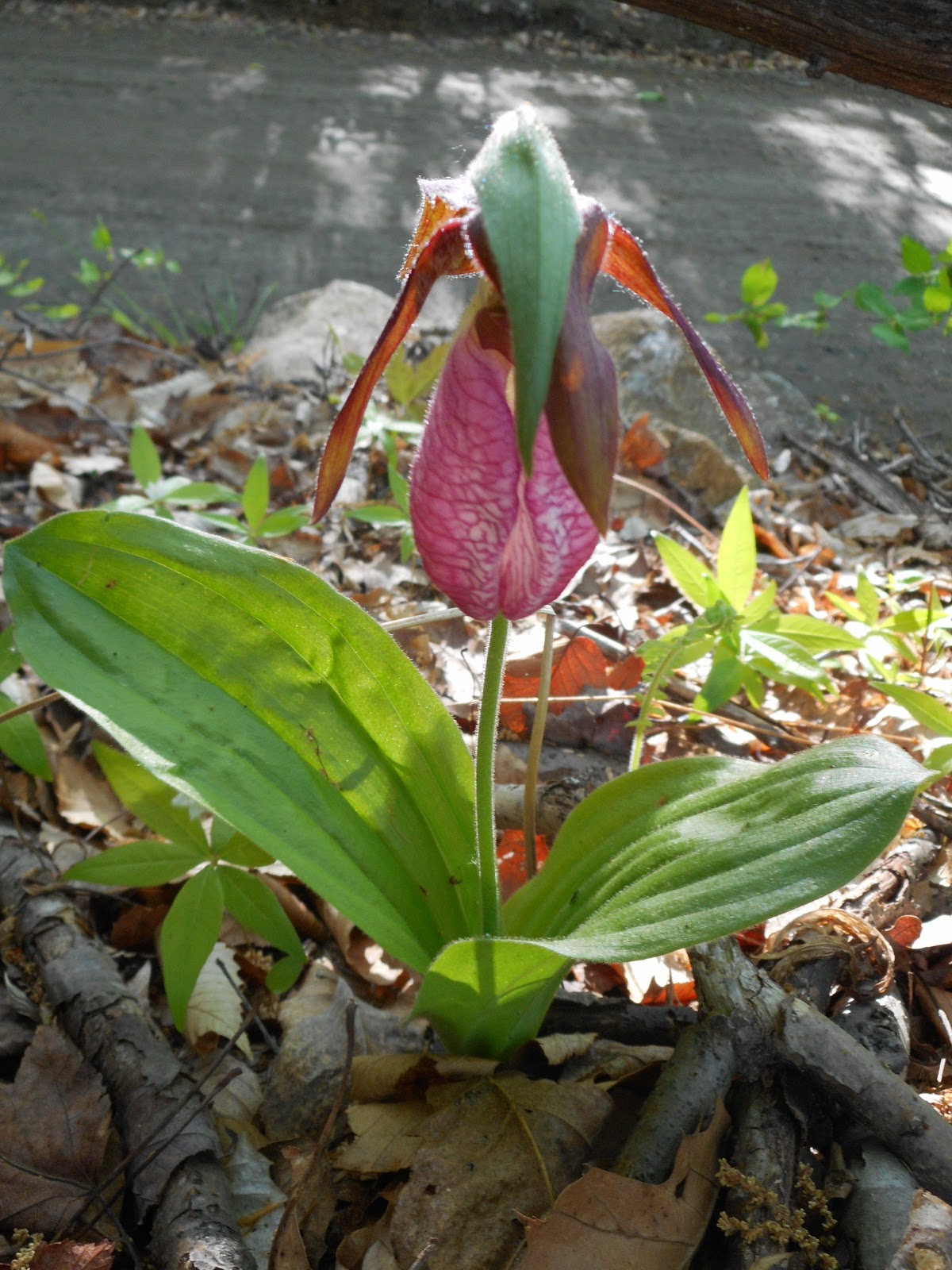 Lady Slippers are so special that when discovered it is like
finding a treasure. Wildflower lovers
will keep their location secret, in fear that those who don’t understand their complexity
will pick them or dig them up. Both
spell disaster to the plant. Just to
germinate, they require acidic soil that contains a fungus of the Rhizoctonia
genus. Like most orchids, their seeds do
not contain a food supply. Under the
right conditions, the fungus will crack the seed and attach itself. It will pass along nutrients to promote
germination and growth. Once the plant is
established and producing its own nutrients, the fungus will extract food
from the slipper’s roots. In this way,
both benefit from their relationship.
Lady Slippers take years to reach the flowering stage and bees are its
sole pollinator. Attracted by color and
scent, the bee enters through the front slit into a one-way labyrinth that
contains no nectar. Near the exit, hairs
will grab onto any pollen the bee may be carrying before depositing new pollen
onto its back. Such an elaborate system
leads to very few flowers being pollinated.
However, a pollinated flower can produce 60,000 seeds. In that a Lady Slipper’s average life span is
20 years with some living much longer, they have a long time to successfully produce
one pollinated flower. (Photo: Donna Roscoe)
Lady Slippers are so special that when discovered it is like
finding a treasure. Wildflower lovers
will keep their location secret, in fear that those who don’t understand their complexity
will pick them or dig them up. Both
spell disaster to the plant. Just to
germinate, they require acidic soil that contains a fungus of the Rhizoctonia
genus. Like most orchids, their seeds do
not contain a food supply. Under the
right conditions, the fungus will crack the seed and attach itself. It will pass along nutrients to promote
germination and growth. Once the plant is
established and producing its own nutrients, the fungus will extract food
from the slipper’s roots. In this way,
both benefit from their relationship.
Lady Slippers take years to reach the flowering stage and bees are its
sole pollinator. Attracted by color and
scent, the bee enters through the front slit into a one-way labyrinth that
contains no nectar. Near the exit, hairs
will grab onto any pollen the bee may be carrying before depositing new pollen
onto its back. Such an elaborate system
leads to very few flowers being pollinated.
However, a pollinated flower can produce 60,000 seeds. In that a Lady Slipper’s average life span is
20 years with some living much longer, they have a long time to successfully produce
one pollinated flower. (Photo: Donna Roscoe)Friday, April 15, 2016
First Spring Butterflies by Allison Archambault
While hiking in late March, I saw my first butterfly of the season; a mourning cloak butterfly (Nymphalis antiopa). I wondered how could it be here so early when most butterflies are en route with the spring migration, and what is it feeding on as the nectar plants aren’t out yet? A few days later I saw a few more of these distinctive large butterflies, with their dark maroon/brown wings with a cream edge and iridescent blue spots just inside the light edges. This got me curious, so I did a little research. I learned that the mourning cloaks are out so early because they don’t all migrate like many other species of butterflies (the monarchs for example). They over-winter hiding in tree cavities and under loose bark in a state similar to hibernation. This gives them an advantage come the spring in that they don’t have to travel long distances to return, and can get a jump start on mating. The adult mourning cloaks feed primarily on tree sap and depend less on nectar, which would explain how they can survive this time of year. They also live up to a year, which makes them one of the longest living butterflies, if you consider how adult monarchs only live for two to six weeks! In the spring, the females lay their eggs on host plants such as willow, elm, hawthorn, hackberry, wild rose and poplar. The larvae which emerge are called spiny elm caterpillars, and they have black bodies with red dots down their back, red legs and a number of long black spines, plus shorter spines with white on the tips. They have voracious appetites for such small creatures and can grow up to two inches long before they pupate and go through the fifteen day process of metamorphoses before the beautiful adult butterflies emerge.
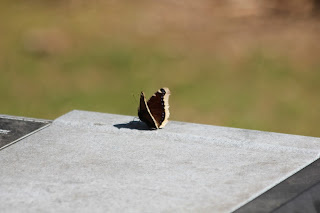 Mourning cloak butterfly (Ann Murray photo)
While hiking in late March, I saw my first butterfly of the season; a mourning cloak butterfly (Nymphalis antiopa). I wondered how could it be here so early when most butterflies are en route with the spring migration, and what is it feeding on as the nectar plants aren’t out yet? A few days later I saw a few more of these distinctive large butterflies, with their dark maroon/brown wings with a cream edge and iridescent blue spots just inside the light edges. This got me curious, so I did a little research. I learned that the mourning cloaks are out so early because they don’t all migrate like many other species of butterflies (the monarchs for example). They over-winter hiding in tree cavities and under loose bark in a state similar to hibernation. This gives them an advantage come the spring in that they don’t have to travel long distances to return, and can get a jump start on mating. The adult mourning cloaks feed primarily on tree sap and depend less on nectar, which would explain how they can survive this time of year. They also live up to a year, which makes them one of the longest living butterflies, if you consider how adult monarchs only live for two to six weeks! In the spring, the females lay their eggs on host plants such as willow, elm, hawthorn, hackberry, wild rose and poplar. The larvae which emerge are called spiny elm caterpillars, and they have black bodies with red dots down their back, red legs and a number of long black spines, plus shorter spines with white on the tips. They have voracious appetites for such small creatures and can grow up to two inches long before they pupate and go through the fifteen day process of metamorphoses before the beautiful adult butterflies emerge.
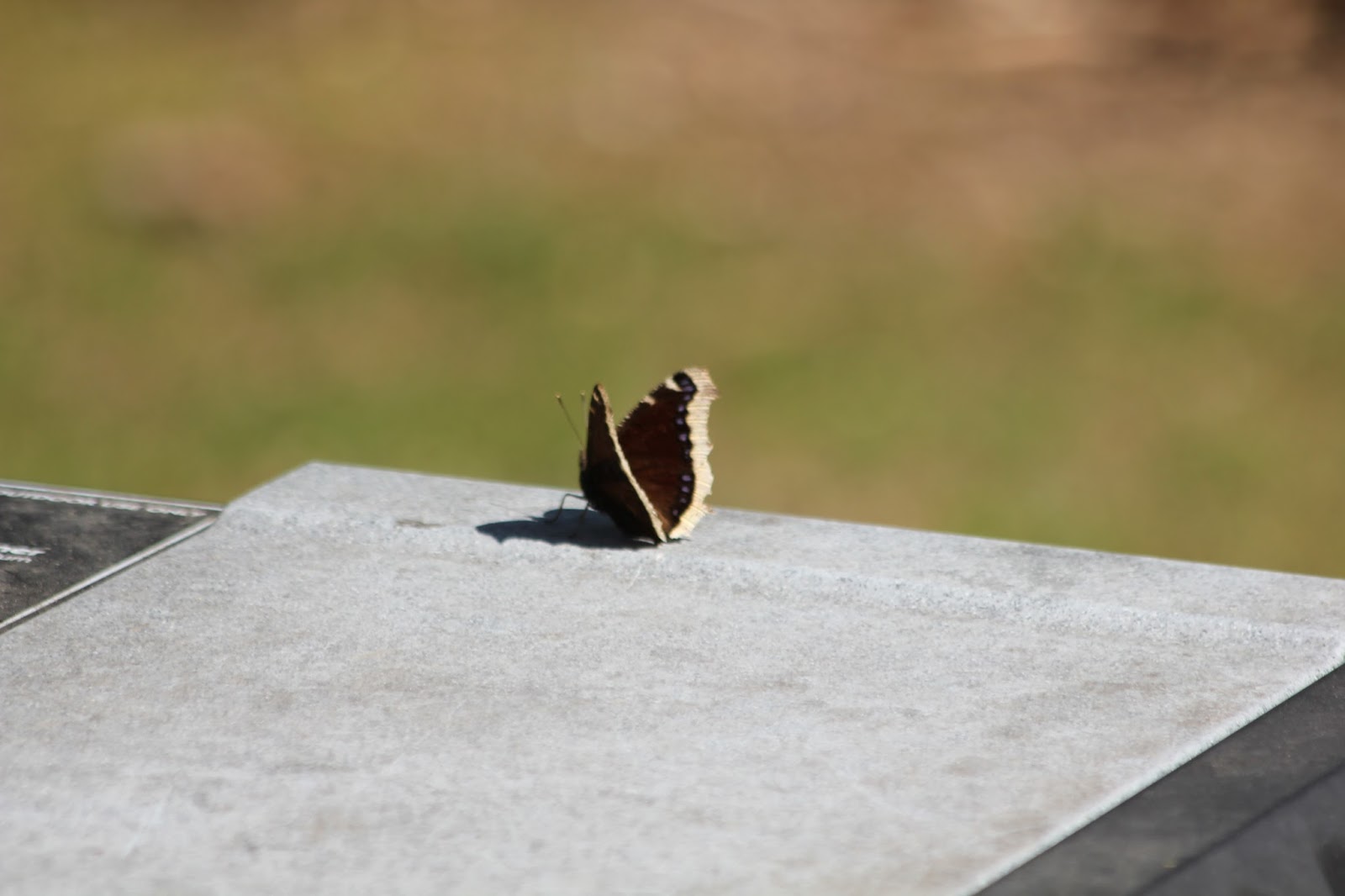 Mourning cloak butterfly (Ann Murray photo)
Sunday, March 20, 2016
The DC Women's Hiking Group will hike Tues., March 22nd and Thurs., March 24th at Scott Lot Preserve in Redding, CT.
Coming from the north on Route 7 turn left onto Old Redding Rd. Right after going under RR bear right onto Mountain Rd. Follow Mountain Rd. to end and turn left onto Peaceable St. Parking for the open space will be on the left. If you come to an electrical substation, you went too far.
Meet at 8:30am.
Sunday, January 31, 2016
The DC Women's Hiking Group will hike Tues., Feb. 2nd and Thurs., Feb. 4th at Bear Mountain Reservation in CT.
Contact: Mendy Polchinski at 203-241-1770 or mmpolchinski@gmail.com.
Take exit 5 off of I-84. Follow Rt. 37 North past all the shopping centers. Go past the
commercialized district and eventually past the federal prison into the more
rural part of northern Danbury. About 0.2 mile past the prison entrance, on
the right, is Bear Mountain Road which is 2.8 miles from I-84. Turn right
onto Bear Mountain Road and follow it for 0.5 mile. Turn right into the
entrance of Bear Mountain Reservation.
Meet at 8:30am. commercialized district and eventually past the federal prison into the more
rural part of northern Danbury. About 0.2 mile past the prison entrance, on
the right, is Bear Mountain Road which is 2.8 miles from I-84. Turn right
onto Bear Mountain Road and follow it for 0.5 mile. Turn right into the
entrance of Bear Mountain Reservation.
Contact: Mendy Polchinski at 203-241-1770 or mmpolchinski@gmail.com.
Subscribe to:
Posts (Atom)

 Posts
Posts

