Saturday, July 7, 2012

July 2012 Constellation of the Month -- the Summer Triangle


The Summer Triangle is not one of the official 88 constellations, but it is nonetheless a prominent and memorable shape made by stars (an "asterism"). It is comprised of the brightest stars of 3 constellations.  You can't miss them; they are the brightest stars east of Arcturus, which is the brightest star in last month's Constellation of the Month: Bootes

The brightest of the 3 stars – Vega, in the constellation of Lyra (the Harp) – is the easternmost one.  To the west and north is Deneb, in the constellation Cygnus (the Swan, also known as the Northern Cross).  To the west and south of Vega is Altair in the constellation Aquila, the Eagle. 

The Summer Triangle is a good "asterism" to get to know.  It is visible about half the year soon after sunset, and it can be useful as a starting point for finding other constellations -- as we'll describe in coming months.

Vega is an important star, because it was used to define the zero point in the scale used to specify the apparent brightness of stars – the magnitude scale.  I say "apparent" brightness, because it describes how bright a star appears to us on earth.  A very bright star (one with a large "absolute" brightness) can appear to us as less bright than a star of average brightness which is much closer to earth.

So, Vega was defined as having a magnitude of 0.  And the brightness of other stars was measured in relation to that.  In order to avoid very large numbers, the magnitude scale is logarithmic, like the Richter scale for earthquake intensity.  A magnitude 1 star is 2.5 times fainter than a magnitude 0 star.  And a magnitude 2 star is 2.5 times fainter than that.  So a magnitude 2 star is 2.5 x 2.5 (6.25) times fainter than a magnitude 0 star. 

Stars brighter than 1.5 magnitude are called 1st magnitude, from 1.5 – 2.5 are 2nd magnitude and so on.  The naked eye in Ridgefield can probably see no farther than 4th magnitude due to light pollution. The other two stars in the Summer Triangle – Altair and Deneb – are magnitudes 0.77 and 1.2, respectively.  So they are also 1st magnitude stars.  By way of comparison, the stars in the Big Dipper are magnitude 2 stars. 

South and west of Arcturus (0.13) in Bootes are Spica (1.0) in the constellation of Virgo and two planets – Mars (currently 1.09)  and Saturn (currently 0.93) – which have been  visiting in that area in recent weeks.  The apparent magnitude of planets varies – in some cases considerably – over the course of weeks and months, since their distances from earth can vary greatly as they make their ways around the Sun.

Andy

Wednesday, June 20, 2012

The Longest Day

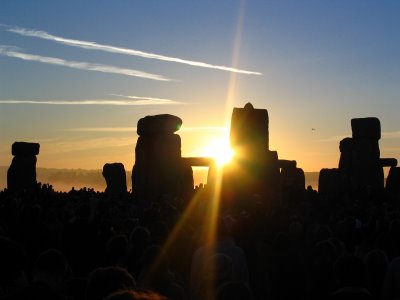
Today is the “Longest” day of the year - the Summer Solstice. Called a variation of Midsummer by most northern cultures, this marks a day of great celebration. When man determined time by the sun and moon, midsummer was the middle of the growing season. Most celebrations took on a joyous quality. At Midsummer food was easier to find, herbs could be gathered and crops had been planted in anticipation of a bountiful harvest. It was considered by some cultures a good time to wed as it fell between the intense work of planting and harvesting of crops. The “downtime” could be spent in preparation and celebrations. In China it was a time of balance. Midsummer celebrated the earth, the feminine, and the yin forces. It complemented the winter solstice which celebrated the heavens, masculinity and yang forces.

Now with modern technology driving our lives, it is barely noticed. However, the natural world will be resetting its internal clocks to reflect the eventual slide toward the cold season. Now is the time for second clutches of eggs or litters and for the young to start their intense survival training. Sunlight drives the natural rhythm of plants. The work of photosynthesis has reached its peak and now food production will decline. With the gradual decrease in sunlight some plants will start setting buds for the next growing season. We owe this all to the 23.5ยบ tilt of Mother Earth. It causes sunlight to be unevenly distributed over our planet’s surface as it orbits around the sun. This creates the seasons – the main driver behind the Rhythm of Life. (Originally posted 6-20-12)

Friday, June 15, 2012

Come join us for our last week of hiking before summer break!
The DC Women's Hiking Group will hike Tues., June 19th and Thurs., June 21st at Pierrepont State Park.
Off Barlow Mountain Road and meet in parking lot at 9:30am.

Sunday, June 10, 2012

The DC Women's Hiking Group will hike Tuesday, June 12th at Weir Farm in Ridgefield, CT.Take Rt. 7 and turn onto Branchville Rd.  Follow National Park signs (Brown signs) to Nod Hill Rd.
Parking area on the left.

On Thursday, June 14th the DC Women's Hiking Group will hike at Pootatuck State Forest in New Fairfield, CT.
Take 84 East to Exit 5 to merge onto Downs St. Continue onto North St. Continue onto CT 37N (Padanram Rd). Continue onto CT 37N (Pembroke Rd). About 2 miles past the interesection for 37 and 39, make a slight right onto Pine Hill Rd. Continue for about 1.7 miles. At fork, keep right. Parking lot is at end of the road at trailhead.
Please bring a picnic lunch for after the hike.
 
Meet at 9:30am for both hikes.


Saturday, June 9, 2012

June 2012 Constellation of the Month: Bootes


The arc of the Big Dipper's handle points to the kite-shaped constellation called Bootes.  At the bottom of the kite is the very bright star Arcturus, which is just south or southwest of directly overhead during June.  In Greek mythology, Bootes is either the Hunter or Herdsman – hunting or herding the bear represented by the Big Dipper (Ursa Major, or Big Bear in Latin).  In June 2012, there are two bright planets Saturn and Mars, which are south and west of Arcturus, in the nearby constellations Virgo and Leo, which was our May 2012 Constellation of the Month.

Arcturus is the 2nd brightest star visible from earth's northern hemisphere, after Sirius, which is in our April 2012 Constellation of the Month, Canis Major.  It just edges out the very bright Vega, in the constellation Lyra, northeast of Bootes.  Arcturus appears orange to the naked eye, and it is classified as a red giant – which is what our sun will become in about 5 billion years, as it nears the end of its life.

There are no exciting nebulae or galaxies in Bootes, but there are some nice double stars which can be seen as such in binoculars.  The best of these is named Izar, or epsilon Bootis.  It has an orange giant close to a white dwarf.  It was given the name Pulcherrima, "most beautiful," by its discoverer. 

Sunday, June 3, 2012

The DC Women's Hiking Group will hike Tues., June 5th and Thurs., June, 7th at
Tarrywile Park in Danbury. Take 84 to the Airport Exit. Take a right at the
light at end of ramp. Follow road to stop sign and make sharp right turn onto
Southern Blvd. Stay on Southern Blvd. There will be signs for Tarrywile
Park. Follow signs and make a right to Tarrywile. Immaculate H.S. will be
on the left and the parking lot for Tarrywile will be on the right side. Meet
at 9:30am.

Tuesday, May 29, 2012

The DC Women's Hiking Group will hike Tues., May 29th and Thurs., May 31st at Topstone Park in Redding, CT.
Take Route 7 to Topstone Rd.
Follow over railroad tracks.
Turns into dirt road.
Parking area will be on the right.
Meet at 9:30am.