Saturday, April 30, 2011

Tree Planting Tips

National Arbor Day was April 29, 2011. Trees are necessary part of a healthy environment. An acre of trees can remove 2.6 tons of carbon dioxide from the air at the same time providing 18 people with their yearly supply of oxygen. One tree produces 260 lbs of oxygen a year. Also, they filter out air & ground pollutants, help control run-off, cool their surroundings, reduce surface evaporation, recycle groundwater back into the atmosphere, leaf-fall returns nutrients to the soil and they provide a habitat for numerous creatures while alive and dead. A fallen tree becomes an mini-ecosystem within itself ending with decomposition which creates soil. So celebrate Arbor Day by planting a tree. Here are some tips from the International Society of Arboriculture
1. Dig the hole 2 -3 times the width of the root ball. Do Not dig deeper than root ball depth.
2. Place the tree in the hole. Partially backfill with the soil from the hole, water to settle the soil, then finish back-filling. Tamp the soil gently, but do not step on the root ball.
3. Do not stake unless the tree has a large crown or could be pushed over by wind or people. Stake for one year maximum
4. Wait till next year to fertilize.

Friday, April 29, 2011

The Year of the Turtle

The turtles have now emerged from their long winter nap. They can be found sunning themselves on a variety of natural and man-made debris or in some secluded woodland spot. Worldwide there are 328 species with 20% of them found in the USA & Canada. But turtles are in trouble. They are the fastest disappearing species on the planet. In CT, 7 out of our 12 species, which includes 4 sea turtles, are either on the endangered, threaten or special concern list. This is why the Department of Environmental Protection has declared this the Year of the Turtle. How can you help them? Leave turtles in the wild; never make them pets. Never release a captive, “store bought”, turtle into the wild. Besides being illegal, it probably won’t survive and they can introduce diseases to the wild population. Do not disturb nesting turtles. If they are nesting in your yard, protect it. It is only temporary. Eventually you will be delighted when the hatchlings emerge. Obviously try to avoid hitting turtles on the road. If it is in June or July, it is probably a pregnant female. If you elect to help it cross, move it onto the side of the road where it is heading. It is going there for a reason and will just try again. Don’t relocate any turtle very far from where you found it. They are territorial and long lived creatures. It may never recover from being moved from its familiar territory. Most importantly, try to learn a little about them. The CT DEP web-site has quick information and links to other sites, plus a Turtle Contest for Kids and a list of CT events. Turtles have existed for 215 million years. Let’s help them stay one of the oldest reptiles on earth. Photo: Eastern Box Turtle - For the CT DEP web-site click here

Tuesday, April 26, 2011

April 26 & 28 Women's Hiking Group

The DC Women's Hiking Group will hike at Ward Pound Ridge Reservation in Pound Ridge, NY
on Tues. Apr. 26th and Thurs., Apr. 28th at 9:30am.
Take Rt. 35 into NY to Rt. 121 and follow signs to Pound Ridge Reservation.
Go in past the parking booth and take 1st right on to Michigan Rd.
Follow Michigan Rd. to end of road and parking area.

Thursday, April 21, 2011

Marsh Marigolds - Spring is here to stay!

The skunk cabbage is the first flower to emerge in the wetlands. Its spadix pops up through the snow sometimes as early as January. But when the yellow blooms of the marsh marigold are first noted dotting our wetlands, spring has finally taken a hold on the land. In the Sarah Bishop Open Space, it was Monday! Their blooms look more like a buttercup than a marigold as in fact it is in the buttercup family – Ranunculaceae. The nectar and pollen are welcomed nourishment for early bees and insects. A native plant it was used for various medicinal purposes. But beware; all parts of the plant are poisonous! Just handling it can cause skin rashes and dermatitis, so preparation required expertise. Because it sickened their livestock, especially cows, colonial farmers were very wary of it. But when its blooms appeared, it meant that the fields could finally be plowed. As with most wildflowers, it has many names – kingcups, water blobs, and sometimes cowslip. Scientifically it is called Caltha (cup) patustris (marsh). Growing along the margins of the wetlands, this beautiful plant takes three years to bloom. So as you are walking along the marsh, swamp or bog, enjoy these little heralds of spring. But remember don’t touch! Beauty sometimes has a bite. (Photo - US Fish & Wildlife, Waubay National Wildlife Refuge)

Friday, April 15, 2011

Frog-sicles?

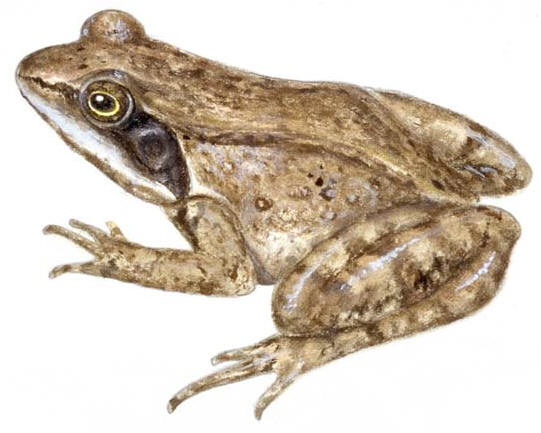
The sounds of spring are reverberating throughout the woodlands. Now we mostly hear spring peeper calls. But in some areas, interspersed in the peeper chorus is a series of short raspy quacks. This is the unique call of the wood frog. Wearing a mask and slightly bigger than the spring peeper, this little creature is so incredibly adapted that it can live above the Arctic Circle. Wood frogs inhabit the woodlands eating a wide variety of insects and other small invertebrates. In the late fall, it crawls beneath the forest floor's leaf litter and goes into a hibernation-like state. Over wintering on dry land and above the frost line would kill most cold-blooded vertebrates. But the wood frog is unique in that it can survive being frozen solid - a frog-sicle! In the very early springtime, it emerges from hibernation and immediately gets to the business of breeding. These otherwise solitary animals congregate in the large woodland puddles created by snow melt and spring rains called vernal pools. There they mate and lay their eggs in large blobs called mats (see photo) usually attached to some form of vegetation. The eggs become coated in symbiotic algae that helps give oxygen to the developing embryo. This makes them easily mistaken for clumps of algae. Depending on the temperature of the water, the egg to tadpole to frog metamorphosis could take from 50 - 120 days. This fast development is necessary as most vernal pools dry up before summer. If you would like to learn how this frog survives freezing see: http://www.youtube.com/watch?v=Fjr3A_kfspM or type "freezing frog" into You Tube's search.

Women's Hiking Group on Vacation 4/19 & 4/21

The DC Women's Hiking Group will not be hiking April 19th and April 21st. No school. Spring break. Enjoy the break!

Monday, April 11, 2011

Nature’s 360 Million Years Old Miracle

About 360 million years ago, seed plants began to appear. Before that many land plants used spores to reproduce. Spores have to survive without built-in nutrition or physical protection. Seeds are nature’s way of making sure that plant embryos didn’t dry out and had some energy to start growth. Thus, encased sometimes in a very tiny shell is the plant’s instruction manual awaiting the right amount of water, proper temperature and location. Some seeds, like the mullein, can wait over a 100 years for this to happen. If it is lucky enough to have landed somewhere that meets all three requirements, it will start to grow, called germination. The food supplies stored within the seed provide the energy. First a root will appear pushing downward into the soil to anchor the new plant and provide it with water and minerals necessary for growth. It is the tiny microscopic root hairs that actually do the work (white fuzzies). At the same time or just a little later, a stem will appear pushing its way up through the soil towards the sunlight. Sometimes baby leaves will be on the stem (green). These are called cotyledon or “seed leaf” and are present in the seed prior to germination. They will be the first leaves of the plant. By having these embryonic leaves, the plant will be able to produce food (photosynthesis) soon after the stem has emerged from the soil. This requires less food to be stored in the seed itself. Frequently cotyledons appear different than any future leaf on the plant. Once the stem or shoot appears above the ground it is called a seedling and germination has ended. Now the seed has done its job of providing instructions, energy and protection. If the plant continues to get the right amount of water, sunlight and nutrients, growth will be successful and it will produce its own seeds -insuring the cycle will begin again. (Photo of bean germination www.visions-of-science.co.uk)