
First Spring Butterflies by Allison Archambault
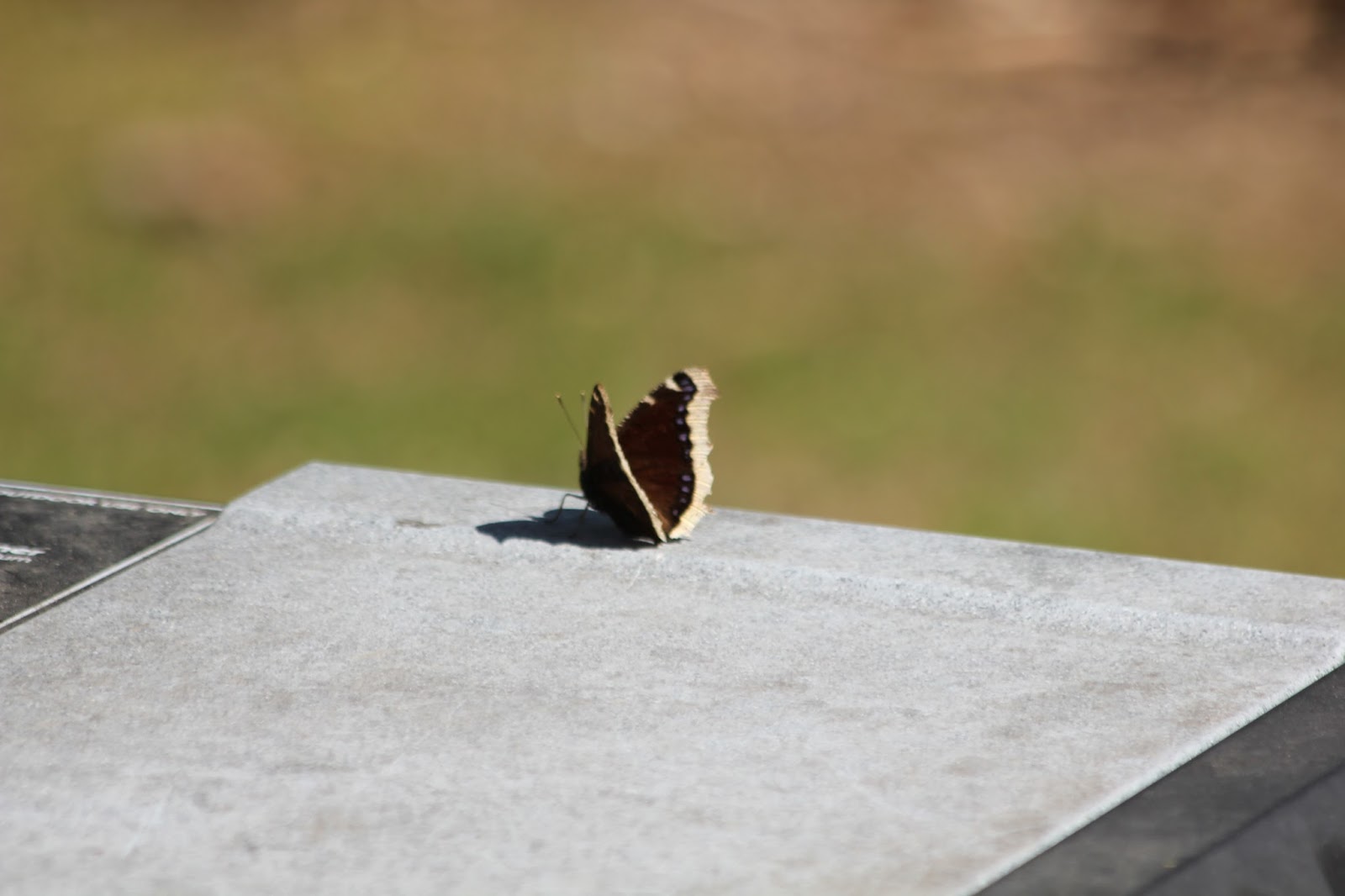
While hiking in late March, I saw my first butterfly of the season; a mourning cloak butterfly (Nymphalis antiopa). I wondered how could it be here so early when most butterflies are en route with the spring migration, and what is it feeding on as the nectar plants aren’t out yet? A few days later I saw a few more of these distinctive large butterflies, with their dark maroon/brown wings with a cream edge and iridescent blue spots just inside the light edges. This got me curious, so I did a little research. I learned that the mourning cloaks are out so early because they don’t all migrate like many other species of butterflies (the monarchs for example). They over-winter hiding in tree cavities and under loose bark in a state similar to hibernation. This gives them an advantage come the spring in that they don’t have to travel long distances to return, and can get a jump start on mating. The adult mourning cloaks feed primarily on tree sap and depend less on nectar, which would explain how they can survive this time of year. They also live up to a year, which makes them one of the longest living butterflies, if you consider how adult monarchs only live for two to six weeks! In the spring, the females lay their eggs on host plants such as willow, elm, hawthorn, hackberry, wild rose and poplar. The larvae which emerge are called spiny elm caterpillars, and they have black bodies with red dots down their back, red legs and a number of long black spines, plus shorter spines with white on the tips. They have voracious appetites for such small creatures and can grow up to two inches long before they pupate and go through the fifteen day process of metamorphoses before the beautiful adult butterflies emerge.
Friday, April 15, 2016
Sunday, March 20, 2016
The DC Women's Hiking Group will hike Tues., March 22nd and Thurs., March 24th at Scott Lot Preserve in Redding, CT.
Coming from the north on Route 7 turn left onto Old Redding Rd. Right after going under RR bear right onto Mountain Rd. Follow Mountain Rd. to end and turn left onto Peaceable St. Parking for the open space will be on the left. If you come to an electrical substation, you went too far.
Meet at 8:30am.
Sunday, January 31, 2016
The DC Women's Hiking Group will hike Tues., Feb. 2nd and Thurs., Feb. 4th at Bear Mountain Reservation in CT.
Contact: Mendy Polchinski at 203-241-1770 or mmpolchinski@gmail.com.
Take exit 5 off of I-84. Follow Rt. 37 North past all the shopping centers. Go past the
commercialized district and eventually past the federal prison into the more
rural part of northern Danbury. About 0.2 mile past the prison entrance, on
the right, is Bear Mountain Road which is 2.8 miles from I-84. Turn right
onto Bear Mountain Road and follow it for 0.5 mile. Turn right into the
entrance of Bear Mountain Reservation.
Meet at 8:30am. commercialized district and eventually past the federal prison into the more
rural part of northern Danbury. About 0.2 mile past the prison entrance, on
the right, is Bear Mountain Road which is 2.8 miles from I-84. Turn right
onto Bear Mountain Road and follow it for 0.5 mile. Turn right into the
entrance of Bear Mountain Reservation.
Contact: Mendy Polchinski at 203-241-1770 or mmpolchinski@gmail.com.
Sunday, January 24, 2016
Saturday, January 9, 2016
Comet Catalina
A visitor from the Orb Cloud, the most outer region of our
solar system, Comet Catalina was first thought to be an asteroid with a short
period orbit. But after further
observation it was determined to have been knocked out of the Orb Cloud by some
passing nameless star long ago and was on a several million year trajectory
course out of our solar system. It was
discovered on Oct 31, 2013 at the Catalina Sky Survey’s Schmidt-Cassegrain
telescope, located in the Catalina Mountains outside of Tucson, Arizona as part
of NASA-funded program to find Near Earth Objects. The comet will come closest to Earth on Jan.
12th, a mere 66.9 million miles away. Officially named C/2013 US10 this one time
visitor to our night sky has two tails. A plasma tail made of ionized gas, and
a dust tail made of small solid particles. Because the escaping gas and dust are affected
by the Sun in slightly different ways, the tails point in slightly different
directions. The core of the comet is
like a dirty snowball. As it approaches
the sun’s warmth the gas and dust sublimate into a glowing atmosphere called
the coma. Scientists believe that Comet
Catalina is a young comet, traveling in a chaotic orbit affected by galactic
tides and passing stars. This fly-by is
really the last it will see of our Sun. As
it sling shoot around the sun, it built up enough velocity to escape the Sun’s gravitational force and continue its wild ride
into the universe beyond. Photo: Amateur
astronomer Rich Tyson, the Slooh Observatories on the Canary Islands Dec. 12.
Friday, December 4, 2015
The DC Women's Hiking Group will meet Tues., Dec. 8th and Thurs., Dec. 10th at Topstone Park in Redding, CT.
Take Topstone Rd. off of Rt. 7.
Follow road over RR tracks until it becomes a dirt road.
Shortly after, a parking area will be on the right side of the road.
Meet at 8:30am.
Any questions, please contact Mendy at mmpolchinski@gmail.com or 203-241-1770.
Take Topstone Rd. off of Rt. 7.
Follow road over RR tracks until it becomes a dirt road.
Shortly after, a parking area will be on the right side of the road.
Meet at 8:30am.
Any questions, please contact Mendy at mmpolchinski@gmail.com or 203-241-1770.
Wednesday, December 2, 2015
October Birding Blog - Garden of Ideas
How is
it that sometimes the best birding occurs right in the parking lot! A very small bird called a kinglet was seen high in a tree,
nervously gleaning insects as we gathered in the parking lot to begin at the
Garden of Ideas. A walk around the marsh
area resulted in some Warbler sightings,
and although we didn’t get close enough to more specifically identify them,
their yellow coloration and shape put us in the right family. A couple of flocks of red-winged blackbirds flew low over the marsh, and high in the sky
was a turkey Vulture with its
characteristic V-shaped silhouette and long fingered wingtips. A white throated sparrow sat in a low bush within easy viewing range, and its very
distinctive black and white striped head and bright white throat patch made it
easy to identify. We saw and heard the
usual assortvment of blue jays, American crows, goldfinches and downy woodpeckers as we walked around the grounds. The eastern phoebe was also spotted, a brown and white flycatcher that sits upright on
a branch and wags its tail in a distinctive manner. Best of all was a red- shouldered hawk (pictured) that sat regally at the top of a dead tree
surveying the marshlands. These medium
sized hawks have reddish under parts and a banded tail, and are often found
near swamps, as they will hunt for frogs and snakes as well as mice. Next month we will see fewer migrants heading
south, and more of the birds that stay for the winter. Photo: www.allaboutbirds.org/Red-shoulderedHawk_JonCorcoran_MD_2011-1059
Subscribe to:
Posts (Atom)

