
The DC Women's Hiking Group will hike this week, Tuesday, April 21st and Thursday, April 23rd at Tarrywille Park in Danbury.
From I-84 take the airport exit.
At end of ramp turn right.
Follow through traffic lights and at stop sign turn onto Southern Blvd. ( It will be a sharp right turn).
Follow small brown signs for Tarrywile Park.
The park will be on the right, across from Immaculate H.S.
Meet in lower parking lot at 8:30am.
Sunday, April 19, 2015

Monday, April 6, 2015
Wednesday, April 1, 2015
Noah's Blog - March
 |
It was not exactly spring-like, as there was a fresh five
inches of snow on the ground with big flakes still falling, but a large group
of all ages set off early in the morning to find avian signs of spring at the
Garden of Ideas on North Salem Road. Bird
song filled the air, mostly from the red-winged
blackbirds, one of the earliest spring migrants to fly up from the southern
states. The males, with their black
bodies and yellow and red shoulder badges, were easy to spot in the area around
the marsh. Noah taught us to listen for
the common grackle, another early
migrant that often comes up in large flocks that include other birds such as
the red-winged blackbirds, brown-headed cowbirds, European starlings, and even American
robins. A red-tailed hawk sat all puffed up on a tree limb surveying the area,
and was unperturbed by the audience observing from below. Birds fluff up their feathers in the cold to
trap air between them for better insulation, and the oils on the feathers
provide waterproofing. A member of the
buteo genus, the red-tailed hawk preys mostly upon rodents, and is one of the
most common hawks found in our area, staying year-round. Perched in another tree was another
year-round inhabitant, the mourning
dove, whose graceful silhouette with a rather small head and long tapering
tail, and its mournful call, make it easy to identify. As we crossed the boardwalk over the marsh, we
found a pair of rather shy ring-necked
ducks that were swimming near the reeds.
The male ring-necked is beautifully marked in black, grey and white,
while the female is brown with a darker crown above a paler face. Both have a peaked head and a distinctive
white ring on their bills, which looks a bit like a “mustache” from a
distance. In fact, the ring around its
neck for which it is named is rather hard to see, so it is much easier to go by
the other features to identify it. Even
though they are one of the ducks that dive for their food, they often frequent
shallow ponds, lakes and marshes. Mallards were also spotted, one of our
most familiar and easily identified ducks with the iridescent green heads and
yellow bills on the males. They are
“dabbling ducks,” as they feed by tipping forward to eat water plants and
hardly ever dive. Woodpeckers were heard
in the distance, both the “wuk” sound of the pileated and the “kwirr” call of the red-bellied woodpecker. Also
in the back of the Garden of Ideas property are some domesticated birds: about
a half dozen hens and a rooster. We were interested to learn that Joe
Keller’s chickens stay outside in
their coop year round, and stop laying eggs for only about six weeks of the
year. Joe plans to fence in a larger
area for them to roam in the spring, so they won’t fall prey to fox and other
predators. We all agreed it was a
beautiful day of birding despite the snow! Picture: Ring-necked ducks Credit: Chris Burke
Icicles!
 Did you know
they were doing serious research on icicles?
Knowing their properties is important for among other things gutter design. Here is an excerpt from The Icicle Atlas by Dr. Stephen Morris
of the University of Toronto:
Did you know
they were doing serious research on icicles?
Knowing their properties is important for among other things gutter design. Here is an excerpt from The Icicle Atlas by Dr. Stephen Morris
of the University of Toronto:
“Icicles are
familiar to anyone living in a cold climate. But what determines their shape
and growth? Their distinctive forms emerge from the complex interplay between
their evolving shape and the flow of air and water over their surfaces. These
flows in turn control the release of heat needed to transform water into ice.
Impurities in the water also play an important role, especially in the
formation of ribs or ripples around the circumference of the icicle.”
Thus, icicles
do not form from water tension and are dependent on air flow and water
impurities. The Atlas can be found
on-line at: http://www.physics.utoronto.ca/Icicle_Atlas/ It has some very interesting pictures and
details growing conditions. So
before you knock down the treasure trove that has been decorating your house,
have a look to see if they match Dr. Morris’ collection. (Picture: Naturally curved icicles on the edge of a roof in Truckee, CA. The icicles kept growing and curled as a mass of icy snow slid down the metal roof. Credit John Larkin - NYTimes Science)
Wednesday, March 11, 2015
Friday, February 20, 2015
Noah's Birding Log - Feb 2015
 February’s bird walk was
quite a challenge with deep snow covering the golf course. Breaking trail with snowshoes required a lot
of work. After one hole, we were warmed up to coat unzipping level. But the day was perfect for birding – no wind and bright grey sky
which allows one to see finer detail at a distance. First bird of the day was the pileated
woodpecker, discovered by hearing its loud pecking sound. Nearly the size of a crow, this is the
largest woodpecker in our area. They
have a long neck, a conspicuous triangular crest (entirely red in males), and a
long chisel-like bill. They are famous
for creating rectangular shaped holes that are be so broad and deep, they can
cause a small tree to break in half. Clues
to their work are large chips of wood on the ground. Their favorite food is carpenter ants but
they are willing to consume numerous other woodboring insects, plus wild fruits
and berries. They have long, barbed tongues
which they use to extract their prey from deep within the wood. Like today, one generally hears them first;
hammering loudly and then you may catch their undulating flight pattern with
strong rapid wing strokes alternating with brief periods of wings folded at their
sides. They are very important to the
forest ecosystem. As primary nest
builders, their numerous excavations provide living quarters or shelter for
many other cavity loving animals, like wood ducks, bluebirds, mice & flying
squirrels. We also managed to spot two
small buteos – soaring hawks. They may
have been red-shouldereds but red-tails nest in that area too. The distance made positive identification impossible
which is a frustrating part of birding. So
without a doubt, the bird of the day was the magnificent pileated woodpecker. It was worth all the energy to see it.
February’s bird walk was
quite a challenge with deep snow covering the golf course. Breaking trail with snowshoes required a lot
of work. After one hole, we were warmed up to coat unzipping level. But the day was perfect for birding – no wind and bright grey sky
which allows one to see finer detail at a distance. First bird of the day was the pileated
woodpecker, discovered by hearing its loud pecking sound. Nearly the size of a crow, this is the
largest woodpecker in our area. They
have a long neck, a conspicuous triangular crest (entirely red in males), and a
long chisel-like bill. They are famous
for creating rectangular shaped holes that are be so broad and deep, they can
cause a small tree to break in half. Clues
to their work are large chips of wood on the ground. Their favorite food is carpenter ants but
they are willing to consume numerous other woodboring insects, plus wild fruits
and berries. They have long, barbed tongues
which they use to extract their prey from deep within the wood. Like today, one generally hears them first;
hammering loudly and then you may catch their undulating flight pattern with
strong rapid wing strokes alternating with brief periods of wings folded at their
sides. They are very important to the
forest ecosystem. As primary nest
builders, their numerous excavations provide living quarters or shelter for
many other cavity loving animals, like wood ducks, bluebirds, mice & flying
squirrels. We also managed to spot two
small buteos – soaring hawks. They may
have been red-shouldereds but red-tails nest in that area too. The distance made positive identification impossible
which is a frustrating part of birding. So
without a doubt, the bird of the day was the magnificent pileated woodpecker. It was worth all the energy to see it. Monday, February 2, 2015
Groundhog Day 2015
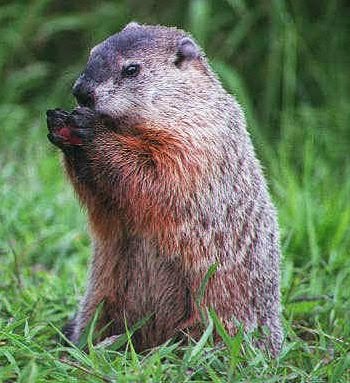
Groundhog Day has its roots deep in the past when nature’s
cycles dominated one’s life. It falls
between the winter solstice and the spring equinox when in the far Northern Hemisphere
winter is at its deepest. At this point
it was important to determine if there was enough food and hay to last till
spring and what adjustments must be made.
Traditions developed to hone in on the date, have evolved over the eons. Some say
the early Christians took the Gaelic festival of Imbolc and converted it to
Candlemas. For centuries this was the
day that the clergy blessed candles and distributed them to the people. Thus reassuring their followers that the
light will continue to grow and the dark of winter was behind them. Regardless of whose traditions one quotes,
this day revolves around the sun. How a
groundhog got involved seems to go back to German folklore where the prognostics
were a badger or bear or a hedgehog. It
peeps out of its winter quarters and if the day is sunny, goes back to sleep
for another 6 weeks. If the day is
cloudy, it stays out to enjoy the mild weather. German settlers brought this tradition to
American, specifically Pennsylvania.
There groundhogs were in abundance and thus took center stage. It is said the first recorded celebration
took place in Morgantown, PA in 1841. Now the largest celebration is held in
Punxsutawney, PA where large crowds have gathered since 1886 to hear Phil’s predictions. However, in CT we have our own prognosticating
rodent, Chuckles VIII. Unlike Phil who
claims to be 125 years old and drinks a magic elixir to maintain his youth,
Chuckles comes from a long line of diviners.
According to his handlers at the Lutz Museum, Chuckles takes a more scientific
approach by “consulting with meteorologists, examining radar data, and reading
the Farmer’s Almanac.” Chuckle’s conclusion:
2015 will have 6 more weeks of winter.
Subscribe to:
Posts (Atom)

 Posts
Posts


