
The DC Women's Hiking Group will hike at Seth Low Pierrepont State Park in Ridgefield on Thurs., Jan. 30th.
The park is located on Barlow Mt. Rd. across from Scotland and Barlow Mt. Elementary Schools.
Meet in the parking area at 8:30am.
Wednesday, January 29, 2014

Sunday, January 19, 2014
Monday, January 13, 2014
Wednesday, January 8, 2014
January 2014 Constellation of the Month -- Taurus
 In December, we followed the band of the Milky Way from our November
constellation, Cassiopeia ("the W"), to the constellation of Perseus.
If we continue in that direction (roughly east) and along the band, we'll see
the constellation of Auriga, which is shaped like a non-symmetrical pentagon. Slightly south and west of Auriga, there is a
prominent constellation which looks like the diagram to the left -- Taurus, the
Bull.
In December, we followed the band of the Milky Way from our November
constellation, Cassiopeia ("the W"), to the constellation of Perseus.
If we continue in that direction (roughly east) and along the band, we'll see
the constellation of Auriga, which is shaped like a non-symmetrical pentagon. Slightly south and west of Auriga, there is a
prominent constellation which looks like the diagram to the left -- Taurus, the
Bull.The head of the bull is the triangle shape at the lower middle in the diagram shown here. The brightest star is Aldebaran. Aldebaran is a red giant star, nearing the end of its life; its diameter is 44 times as wide as the Sun. In about 5 billion years, the Sun will cool and expand and become a red giant itself.
The two horns of the Bull are marked by the two stars in the upper left of the diagram. Near the tip of the left horn is M1, the Crab Nebula. It is a cloud of expanding gases which are the aftermath of a star which exploded (a supernova) in the year 1054.
Aldebaran appears to be in the middle of a cluster of stars called "the Hyades", which fills up the triangle of Taurus's head. This is a group of about 200 stars that formed at the same time and which are moving together. Aldebaran is in our line-of-sight to this cluster, but it is much closer.
An even more interesting star cluster is the Pleiades, also known as the "7 Sisters". Somewhat north and west of Aldebaran, they form a uniquely memorable shape of a number of easily visible stars close together. It looks like a mini-dipper. The Subaru logo is taken from the shape of the Pleiades. Some people can see 5 stars with the naked eye, others 7, and others can see more. A telescope will show hundreds of stars surrounded by a nebula -- a vast cloud of interstellar gases and dust. In many nebulae with star clusters, the stars were formed from the nebula. But in this case, they are just passing through each other -- at a speed of about 25,000 miles per hour.
Thursday, December 12, 2013
Friday, December 6, 2013
December 2013 Constellation of the Month: Perseus
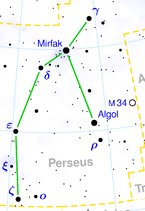
Last month's constellation,
Cassiopeia - the "W", is almost directly overhead around 7 PM. If you
look slightly south and east of this W, you'll find Perseus. It is shaped like
a wishbone which points at Cassiopeia. The band of the Milky Way runs from
Cassiopeia through Perseus. (See last month's Constellation of the Month post
on this blog for more on the band of the Milky Way).
Perseus's brightest star, Algol,
is actually 3 stars. Two revolve around each other (actually around a point in
between them) and the 3rd moves along a large elliptical path outside the other
two. More than half the stars in our Milky Way galaxy are multiple stars
-- doubles, triples, sextuples, etc.
Algol is also a variable star
-- which are much less common than multiple stars. About every 3 days, Algol's
brightness drops by about 70%. This occurs when the larger, but fainter, star
passes in front (as viewed from the Earth) of the brighter star. In addition to
eclipsing variables like Algol, other variable stars are caused by pulsing -- a
star actually expands and shrinks periodically. The brightness of some variable
stars can vary by a factor or 1,000 or more in a period of less than a year.
Perseus is also home to M 34 --
an open cluster of about 400 stars, which is easily seen with binoculars. An open
cluster is a group of stars which were formed from the same nebula
(huge cloud of gasses) at roughly the same time -- about 200 million years ago
for M34. This is very young as stars go; the Sun is about 5 billion years old.
M34 appears to cover an area in the sky about the size of the full moon. It's
about 7 light years across, and about 1,500 light years away. A light year
is about 6 trillion miles, which is the distance light travels in one year. So,
when you're looking at this cluster, you're actually seeing it as it was 1,500
years ago.
Monday, December 2, 2013
Subscribe to:
Posts (Atom)

 Posts
Posts


