Monday, October 7, 2013

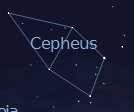
October 2013 Constellation of the Month – Cepheus


Cepheus is somewhat fainter than better-known constellations.  But, it is easy to find, since parts of several prominent constellations point to it.  It is between Cassiopeia, "the W", and Cygnus, the Northern Cross.  The easternmost leg of the W and the head of the Cross both point to it.  If you extended northward the lines which form the east and west sides of Pegasus's "square" they would intersect in Cepheus.  

Some people think of Cepheus as a pentagon, others say it looks like a house a child might draw.  In Greek mythology, Cepheus was the king of Ethiopia.  His wife, the queen, was Cassiopeia.  His daughter was Andromeda, whose constellation extends out from the northeast star in the square of Pegasus.

Cepheus is a circumpolar constellation for observers in the northern hemisphere.  That means it is positioned close enough the North Star (which it appears to circle daily and yearly) so that it never sets..

Delta Cephei is a very famous and important star. It more than doubles its brightness, and fades back, over a regular period of 3 days, 5 hours, 37 minutes. Its name is used for a whole class of pulsating variable stars which behave similarly.  If one knows the length of the period over which a Cepheid variable star varies, one can calculate its luminosity.  Luminosity is the absolute brightness of a star – how bright it would appear if all stars were at the same distance from the observer.  Using these calculations, about 100 years ago, astronomers found that the distance of one Cepheid variable in the Andromeda galaxy was about 3 million light years away.  So it confirmed the Andromeda group of stars was far outside our Milky Way galaxy, and was itself a galaxy.  Since then, it has been regularly used to calculate distances to star clusters and galaxies.  

Another famous variable star in Cepheus is Mu Cephei, known as the Garnet Star,   because of its striking red color

Monday, September 30, 2013

The DC Women's Hiking Group will hike this week, Oct. 1st and Oct. 3rd at Tarrywille Park in Danbury.

From I-84 take the airport exit.
At end of ramp turn right.
Follow through traffic lights and at stop sign turn onto Southern Blvd. ( It will be a sharp right turn).
Follow small brown signs for Tarrywile Park.
The park will be on the right, across from Immaculate H.S.
Meet in lower parking lot at 8:30am.

Monday, September 23, 2013

The DC Women's Hiking Group will hike Tues., Sept.,24th and Thurs., Sept., 26th at Scott Lot Preserve in Redding, CT.
Coming from the north on Route 7 turn left onto Old Redding Rd. Right after going under RR bear right onto Mountain Rd. Follow Mountain Rd. to end and turn left onto Peaceable St. Parking for the open space will be on the left. If you come to an electrical substation, you went too far.
Meet at 8:30am.

Saturday, September 14, 2013

The DC Women's Hiking Group will hike Tues., Sept. 17th and Thurs., Sept. 19th at Lake Windwing in Ridgefield.
From Rt. 35 going towards Rt. 7, turn left onto Limestone Rd. at traffic light.
Follow road as it turns into Bennett's Farm Rd.
Across from Ridgebury Elementary School, turn right on to South Shore Drive.
Follow road to parking area on left.
Meet at 8:30am.

Sunday, September 8, 2013

The DC Women's Hiking Group will hike Tues., Sept. 10th and Thurs., Sept. 12th at Bennett's Pond State Park in Ridgefield.
Take Rt. 7 to Bennett's Farm Rd.
Follow about 1 mile.
Look for brown State Park sign and parking area will be on right side of road.
Meet at 8:30am in parking area.

Monday, September 2, 2013

The DC Women's Hiking Group will hike Tues., Sept. 3rd at Topstone Park in Redding, CT.
Take Topstone Rd. off of Rt. 7.
Follow road over RR tracks until it becomes a dirt road.
Shortly after, a parking area will be on the right side of the road.
Meet at 8:30am.

NOTE:  No hike on Thurs., Sept. 5th due to No School.

Sunday, September 1, 2013

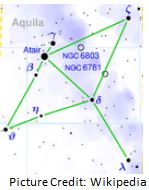
2013 09 Constellation of the Month – Aquila


Aquila, the Eagle is a fairly easy constellation to identify.  Along with last month's constellation of the month, Lyra, and the October 2012 constellation of the month, Cygnus, Aquila's brightest star, Altair makes up the large and prominent Summer Triangle of stars.  Aquila is the southernmost of these three constellations.

Altair is the 12th brightest star in the night sky, at magnitude 0.77.  It is very close to use – only 16.3 light years away, or 4 times as far away as the closest star, Alpha Centauri.   Altair rotates very rapidly, at almost 300 kilometers per second – about 150 times faster than our Sun.  As a result of this rotation, Altair is not spherical, but is flattened at the poles.  

Aquila's immediate neighbors are small and rather faint constellations, such as Delphinus, Scutum, Vulpecula, Sagitta, Capricornus, and Equuleus.  The tail of Serpens points to Aquila from the East.  

The band of the Milky Way passes through Aquila on the way from Cygnus to the North and Sagittarius to the South.  When we look at the band of the Milky Way, we are looking along the plane of our disc-shaped galaxy.  As a result, we see many more starts than if we look above or below the plane.  We would also expect there to be many more nebulae and star clusters, but those in the line of sight of Aquila are relatively faint.  

Coincidentally, there are very few galaxies to be found looking in the direction of Aquila.  So, there are no Messier objects in Aquila.  The French astronomer Charles Messier cataloged a list of 110 hazy objects in the sky.  He was trying to identify these objects -- which appeared to stay in the same place -- in order to distinguish them from moving comets, for which he was searching.  The objects he cataloged turned out to be nebulae (clouds of gases) in our galaxy and distant galaxies themselves. But nothing in Aquila makes this Top 110.