
The DC Women's Hiking Group will hike Tues., Jan., 10th and Thurs., Jan. 12th at Tarrywile Park in Danbury.
Take 84 to the Airport Exit.Take a right at the light at end of ramp.Follow road to stop sign and make sharp right turn onto Southern Blvd.Stay on Southern Blvd.
There will be signs for Tarrywile Park.
Follow signs and make a right to Tarrywile.
Immaculate H.S. will be on the left and the parking lot for Tarrywile will be on the right side.
Meet at 9:30am.
Wednesday, January 11, 2012

Wednesday, January 4, 2012
Jan, 2012 Constellation of the Month: Perseus

Last month's constellation, Cassiopeia - the "W", is almost directly overhead around 6 PM. If you look slightly south and east of this W, you'll find Perseus. It is shaped like a wishbone which points at Cassiopeia. The band of the Milky Way runs from Cassiopeia through Perseus. (See last month's Constellation of the Month post on this blog for more on the band of the Milky Way).
Perseus's brightest star, Algol, is actually 3 stars. Two revolve around each other (actually around a point in between them) and the 3rd moves along a large elliptical path outside the other two. More than half the stars in our Milky Way galaxy are multiple stars -- doubles, triples, sextuples, etc.
Algol is also a variable star -- which are much less common than multiple stars. About every 3 days, Algol's brightness drops by about 70%. This occurs when the larger, but fainter, star passes in front (as viewed from the Earth) of the brighter star. In addition to eclipsing variables like Algol, other variable stars are caused by pulsing -- a star actually expands and shrinks periodically. The brightness of some variable stars can vary by a factor or 1,000 or more in a period of less than a year.
Perseus is also home to M 34 -- an open cluster of about 400 stars, which is easily seen with binoculars. An open cluster is a group of stars which were formed from the same nebula (huge cloud of gasses) at roughly the same time -- about 200 million years ago for M34. This is very young as stars go; the Sun is about 5 billion years old. M34 appears to cover an area in the sky about the size of the full moon. It's about 7 light years across, and about 1,500 light years away. A light year is about 6 trillion miles, which is the distance light travels in one year. So, when you're looking at this cluster, you're actually seeing it as it was 1,500 years ago.
For the mythological soap-opera in which Perseus plays a role, scroll down to see Donna's post on Cassiopeia's Story.
Tuesday, January 3, 2012
Women's Hiking: Jan 3 & 5th
The Discovery Center's Womens Hiking Group will meet at Lewisboro Park in NY this week, Tues., Jan. 3rd and Thurs., Jan. 5th.
Located on the south side of 35 between Mead Street and Bouton Road in South Salem.
Meet at 9:30am.
Located on the south side of 35 between Mead Street and Bouton Road in South Salem.
Meet at 9:30am.
Monday, January 2, 2012
Cassiopeia's Story - The W in the Sky
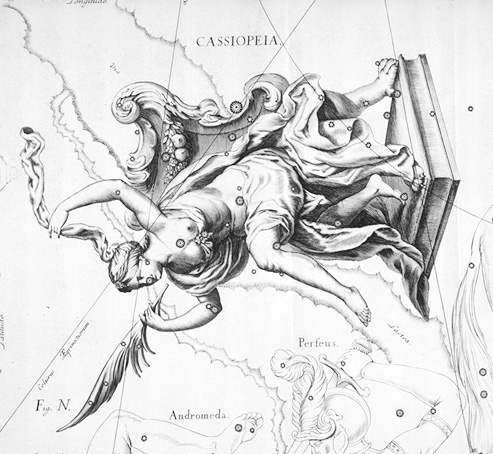 Constellations have been the GPS for travelers throughout history. To make them easier to remember, often stories were told about them. Sometimes the story involved multiple constellations. In Cassiopeia’s case, beside herself, five other constellations are involved – Cepheus, Andromeda, Cetus, Perseus, & Pegasus – at least in this version.
Cassiopeia was the vain wife of King Cepheus of Ethiopia. (They are the only husband and wife among the constellations.) Together they had a daughter Andromeda. One day, Cassiopeia boasted she was more beautiful than the sea nymphs. The sea nymphs, who were goddesses, were outraged. One of them, Amphitrite appealed to her husband Poseidon, God of the Sea, to punish Cassiopeia for her vanity. Poseidon sent a sea monster Cetus to destroy Ethiopia. With his kingdom in peril, Cepheus consulted an oracle for advice. He was told the only way to save his realm was to sacrifice Andromeda to Cetus. Reluctantly, he had his poor daughter chained to a seaside rock. Just as Cetus was about to eat her, he felt a sharp pain in his back. He turned and there was the hero Perseus atop the winged-horse Pegasus, sword in hand. The battle between monster and hero raged until Perseus who had just returned from slaying the snake-headed Medusa dragged her head out of a sack. One look at Medusa’s face turns living creatures to stone. Cetus looked and was immediately solidified. Smitten, Perseus claimed Andromeda for his bride and took her home. While the gods made constellations of them all, the arrogant Cassiopeia was condemned to circle the star Polaris forever in her throne. This results in her hanging upside down in an undignified position for half the year. But even then, she is fussing with her hair.
Monday, December 19, 2011
The DC Women's Hiking Group will hike this week Tues., Dec. 20th and Thurs., Dec. 22nd at Pierrepont State Park.
Meet in parking area off of Barlow Mountain Road at 9:30am.
Wishing everyone a very Merry Christmas and a Happy New Year!!
The group will meet again when school starts up on Tues., Jan. 3rd.
Meet in parking area off of Barlow Mountain Road at 9:30am.
Wishing everyone a very Merry Christmas and a Happy New Year!!
The group will meet again when school starts up on Tues., Jan. 3rd.
Thursday, December 8, 2011
Constellation of the Month - Cassiopeia, the "W"
 Cassiopeia is a "W"- shaped
constellation almost directly overhead and slightly north in December
soon after sunset. Cassiopeia is an interesting constellation for
several reasons.
Cassiopeia is a "W"- shaped
constellation almost directly overhead and slightly north in December
soon after sunset. Cassiopeia is an interesting constellation for
several reasons.
1. It's Circumpolar:
It's one of a few constellations that never rise and never set.
They just (appear to) go in circles around the North Star -- every
day a circle, and every year a much slower circle. At 6AM tomorrow
it will be low in the sky to the north, and 6 months from now in the
evening, it will be about the same place.
If
you lived at the North Pole, all the stars you could see would be
circumpolar. But they'd only be half the stars in the sky, because
the other half -- which you would never see -- would be circumpolar
for those penguins looking up from the South Pole.
2. It's always opposite the Big
Dipper,
with the North Star about midway between them. So, if you look north
from Cassiopeia, and keep going north and lower in the sky, you'll
find the Big Dipper low in the north. 3 months ago and 3 months from
now, they were opposite each other east to west.
3. The band of the Milky Way
goes through it.
We're in the Milky Way galaxy, which is shaped like a disk. When we
see it as a fuzzy band of many, many stars, we're looking along the
plane of the disk, so we see what looks like a band of stars. When
we look anywhere except along this plane we just see a few stars that
are close, and that's what the rest of the sky (outside the band) looks like.
Sunday, December 4, 2011
The DC Women's Hiking Group will meet Tues., Dec. 6th and Thurs., Dec. 8th at Scott Preserve in Redding, CT at 9:30am.
From the north down Rt 7. Turn left onto Old Redding Rd (I believe that is where Walpole used to be). Right after you go under the RR bear right onto Mountain Rd. Take Mountain Rd to Peaceable St and turn left onto Peaceable. The parking for the open space is on the left. I don't remember how far along on Peaceable it is, but I believe if you come to an electrical substation on the right you have gone too far.
There is limited parking, so please carpool, if possible.
From the north down Rt 7. Turn left onto Old Redding Rd (I believe that is where Walpole used to be). Right after you go under the RR bear right onto Mountain Rd. Take Mountain Rd to Peaceable St and turn left onto Peaceable. The parking for the open space is on the left. I don't remember how far along on Peaceable it is, but I believe if you come to an electrical substation on the right you have gone too far.
There is limited parking, so please carpool, if possible.
Subscribe to:
Posts (Atom)

 Posts
Posts

