
Paper is a common material with individual Americans using about 580 pounds of it per year.
But during much of history, paper was rarely used.
In Europe, it wasn’t until the 15
th Century that it became a practical item.
Johann Gutenburg perfection of the movable type and subsequent printing of the Bible in 1450’s is considered the birth date of modern paper.
However, there is much more to the story.
In Egypt 5000 years ago, the marsh grass papyrus was soften and woven into mats, pounded thin and left to dry in the sun.
The resulting sheets were ideal for writing.
It soon became the favored writing medium for the Egyptians, Greeks and Romans.
Other cultures developed similar material – the 2
nd Century Mayans and some Pacific Islanders.
However, these types of mat-like mediums are similar to paper in function but not structure.
True paper is thin sheets made from fiber that has been soaked and soften until each individual filament is a separate unit.
It was T’sai Lun of China in 105 A.D. who is credited with developing the technique of true paper making.
T’sai Lun’s thin, yet flexible and strong paper had a fine, smooth “distinguished” surface perfect for writing.
The Chinese kept papermaking a secret until the 3
rd Century when it started to creep throughout the Far East.
In the 8
th Century it reached the Islamic Middle East.
The muslin Moors introduced the process to the European continent in the 12
th Century.
There it slowly caught on replacing the expensive animal skin parchment.
Once it was readily available, interest turned back to the Chinese and their printing methods.
And it is from them Gutenburg got his inspiration for movable type.
But that is not the whole story either!
About the same time as Gutenburg’s Bible, the Aztecs of modern Mexico independently developed paper from the agarve plant and were making books called codices - pictured is a copy of a page from the Madrid Codex ca. 15th Century- credit Historyforkids.org

 The sounds of spring are reverberating throughout the woodlands. Now we mostly hear spring peeper calls. But in some areas, interspersed in the peeper chorus is a series of short raspy quacks. This is the unique call of the wood frog. Wearing a mask and slightly bigger than the spring peeper, this little creature is so incredibly adapted that it can live above the Arctic Circle. Wood frogs inhabit the woodlands eating a wide variety of insects and other small invertebrates. In the late fall, it crawls beneath the forest floor's leaf litter and goes into a hibernation-like state. Over wintering on dry land and above the frost line would kill most cold-blooded vertebrates. But the wood frog is unique in that it can survive being frozen solid - a frog-sicle! In the very early springtime, it emerges from hibernation and immediately gets to the business of breeding. These otherwise solitary animals
 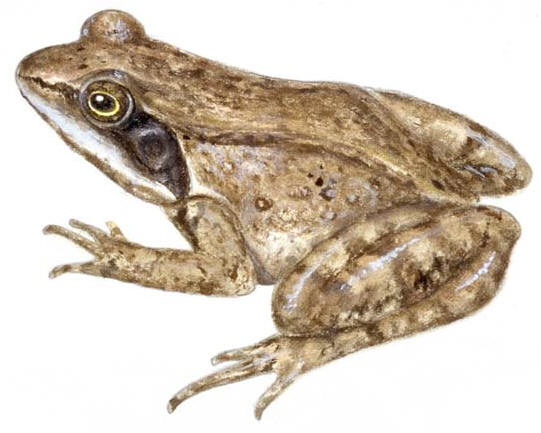 congregate in the large woodland puddles created by snow melt and spring rains called vernal pools. There they mate and lay their eggs in large blobs called mats (see photo) usually attached to some form of vegetation. The eggs become coated in symbiotic algae that helps give oxygen to the developing embryo. This makes them easily mistaken for clumps of algae. Depending on the temperature of the water, the egg to tadpole to frog metamorphosis could take from 50 - 120 days. This fast development is necessary as most vernal pools dry up before summer. If you would like to learn how this frog survives freezing see: http://www.youtube.com/watch?v=Fjr3A_kfspM or type "freezing frog" into You Tube's search.



 Posts
Posts

